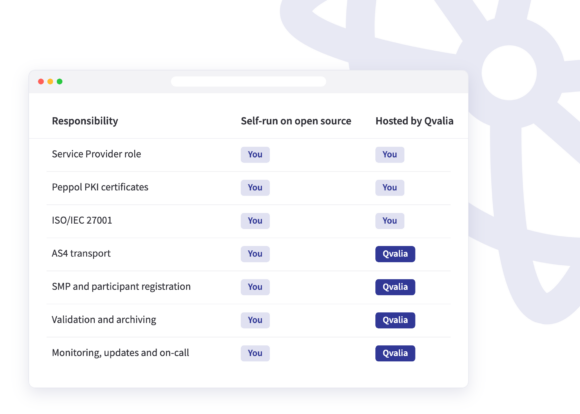
Some organizations need to hold the Peppol Service Provider role in their own name: a software vendor entering a mandated market, a service provider applying for national accreditation, or a group that wants full control of its e-invoicing infrastructure. They usually compare two routes. One is to build and run the Access Point yourself, for example on open-source software such as Oxalis or phase4. The other is to outsource the operations through a Hosted Access Point, where your organization holds the role and the certificates while another provider operates the infrastructure.
If what you need is Peppol for many customers inside your own product, you may not need the Service Provider role at all. With Embedded Peppol, Qvalia holds the role and operates the Access Point, and you register and connect your customers through one API, each with its own Peppol ID where required.
This guide compares the routes as of October 2026: what stays your responsibility in either case, what open-source Access Point software covers and what it leaves to you, the network requirements that take effect in 2027, and where national accreditation adds its own conditions.
Do you need the Peppol Service Provider role?
Holding the role means signing a Service Provider Agreement, meeting OpenPeppol’s security and reporting requirements, and answering to the relevant Peppol Authority for the traffic you carry. If the goal is to let your customers send and receive e-invoices from your product, you can do that without becoming a Service Provider. With Embedded Peppol or a white-label platform, Qvalia holds the role and the certification obligations.
The role is worth taking on when a regulator, a contract or your business model requires it. Examples are national regimes such as the UAE’s, where the accredited provider must be the party of record, and organizations that sell Peppol access as their own service. The partner overview compares the three delivery models.
The deciding question is often the market. Where Qvalia holds the accreditation your customers need, Embedded Peppol covers it. Where national rules require you to be the accredited party yourself, or where you sell Peppol access under your own identity, you need the role.
What is always the Service Provider’s responsibility
Whether you run the Access Point yourself or use a Hosted Access Point, these obligations sit with your legal entity:
- OpenPeppol membership in a Service Provider category, and a Service Provider Agreement with the relevant Peppol Authority, or with OpenPeppol as Coordinating Authority where no national authority applies.
- Your own Peppol PKI certificates, for testing and for production.
- ISO/IEC 27001 certification covering your Peppol scope. OpenPeppol makes it mandatory for all Service Providers by 1 July 2027 (Peppol Authority Italy, July 2026). A hosting provider’s certificate cannot be inherited.
- Verification of your end users, Peppol governance, incident reporting and the contracts with your customers.
- Additional requirements set by the Peppol Authority or national regime in each market you serve.
OpenPeppol’s fees are the same in both cases. For a company with 11 to 50 employees in the Access Point and SMP category, OpenPeppol lists EUR 2,100 to join, EUR 3,700 a year, plus a EUR 2,500 certification fee that is billed on first certification and then added to the annual fee (OpenPeppol fees).
Open-source software for your own Peppol Access Point
Several open-source projects implement the Peppol AS4 profile, the protocol Access Points use to exchange documents. They differ in how much they include beyond transport and in how they fit into your systems.
| Software | Maintained by | License | What it covers |
| Oxalis-NG | NorStella Oxalis Community, Norway | LGPL-3.0 | Standalone Access Point: AS4 sending and receiving, SMP lookup and MLS. Inbound messages are stored on the file system by default, with pluggable storage. Community support. |
| phase4 | Philip Helger | Apache-2.0 | Java library for AS4 sending and receiving with a Peppol profile, built into your own application. Commercial support is available. |
| phoss-ap | Philip Helger | Apache-2.0 | Standalone Access Point built on phase4: SMP lookup, MLS with service level monitoring, Peppol reporting, database storage and forwarding over HTTP, S3 or SFTP. |
| Domibus | European Commission | EUPL 1.2 | The EU eDelivery AS4 reference implementation. Extensive configuration, which KoSIT describes as having a steep learning curve. |
| Holodeck B2B | Chasquis Consulting | GPL-3.0 (LGPL for shared interfaces) | AS4 implementation. According to KoSIT, the dynamic discovery components that Peppol requires are not open source. |
Oxalis is widely used in the Peppol network. It was first developed by SendRegning and maintained by the Norwegian agency Difi until March 2020. The classic Oxalis-AS4 line is frozen at version 7.2.0, and the project directs users to Oxalis-NG, which reached version 1.5.0 in September 2026. Its release notes show what keeping any Access Point current involves: MLS support, removal of the G2 Peppol PKI after OpenPeppol revoked those certificates on 20 April 2026, and new default domains as OpenPeppol takes over the SML from the European Commission.
Sources: the projects’ own repositories and KoSIT’s Comparison of AS4 solutions for Peppol (August 2023). Check each project’s current release before you choose.
What you build and run around the transport layer
A production Access Point needs more than AS4 transport. Depending on the software you choose, some of these parts are included and the rest are yours to build and operate:
- An SMP where your customers are registered with the document types they can receive. This is a separate component, for example the open-source phoss SMP. See how SMP and SML work.
- Validation of business documents against Peppol BIS, EN 16931 and national rules, updated with each specification release.
- The logic that produces MLS responses, and measurement of response times against the service levels below.
- Statistics reports to OpenPeppol.
- Integration with your ERP or platform, storage, archiving and a user interface.
- Tax data reporting in five-corner markets such as Slovakia and the UAE, where the provider also reports to the tax authority.
- Certificate renewal, code list updates, monitoring and on-call support around the clock.
For a team that already runs Java services and PKI in production, none of this is unusual. It is a permanent operating commitment rather than a one-time project.
Peppol network requirements for Access Points in 2027
| Requirement | Date | What it means |
| MLS receiving | 28 February 2027 | The capability to receive Message Level Status must be in production. |
| MLS sending and service levels | 31 March 2027 | Sending MLS is mandatory. Response-time requirements of 20 and 25 minutes for 99.5% of qualifying messages become enforceable. |
| ISO/IEC 27001 | 1 July 2027 | Every Service Provider must hold the certification. |
| Statistics reporting | Every reporting period | End-user statistics reports to OpenPeppol, also for periods without traffic. |
Sources: OpenPeppol’s MLS phase-in plan (July 2026), the ISO/IEC 27001 timeline published by Peppol Authority Italy and the End User Statistics Reporting specification. Check OpenPeppol’s current plans before you commit to a schedule.
Country-specific accreditation for Peppol Service Providers
OpenPeppol sets the baseline. Many markets add their own approval, and it applies whichever software runs the Access Point.
United Arab Emirates
E-invoicing in the UAE runs through Accredited Service Providers approved by the Ministry of Finance under Ministerial Decision No. 64 of 2025, as amended by Ministerial Decision No. 56 of 2026. Applicants need, among other things, a UAE company with paid-up capital of at least AED 50,000, ISO 22301 certification, ISO/IEC 27001 for the product they deliver on, professional indemnity, crime and cyber fraud insurance, and completed onboarding and production testing with the Federal Tax Authority. A third-party product is allowed, and the applicant keeps full responsibility for the service. Read the UAE e-invoicing guide.
France
France’s reform went live on 1 September 2026: every VAT-registered business must be able to receive e-invoices, and small and micro businesses start issuing on 1 September 2027. Invoices are exchanged through plateformes agréées (approved platforms), which the tax administration DGFiP registers once they meet the regulatory requirements and pass technical and interoperability tests. The DGFiP publishes the list of registered platforms (Ministry of the Economy, January 2026). It is also the Peppol Authority for France and sets its own requirements for Service Providers operating there. A platform that is registered or applying as a plateforme agréée can run its Access Point on Qvalia’s infrastructure under its own Service Provider role. Read more on our France e-invoicing page.
Slovakia
Domestic e-invoicing from 1 January 2027 runs through certified delivery service providers on the Financial Administration’s list. A platform that does not want its own certification can be registered as a delivery service intermediary under a certified provider, which then takes responsibility for the intermediary’s compliance.
Norway
The Norwegian Peppol Authority requires providers to verify end users against the Central Coordinating Register for Legal Entities, check that the person signing for an end user is authorized to do so, and report statistics. Public sector receivers must be registered in ELMA, the central SMP operated by Digdir. More in our ELMA article.
Oman
Oman runs its own accreditation for Fawtara service providers, described on our Oman e-invoicing page.
Australia
The Australian Taxation Office (ATO) is the Peppol Authority in Australia and accredits Access Points and SMPs. Applicants sign the Peppol Service Provider Agreement and go through due diligence, including a criminal record check and professional indemnity insurance of at least AUD 1 million per occurrence. They complete the A-NZ eInvoicing Security Questionnaire, as a self-assessment or with an independent audit against ISO/IEC 27001 or the Australian or New Zealand Information Security Manual (ISM), and pass the Peppol Testbed, including the PINT A-NZ interoperability tests. Accreditation is reviewed every year (ATO accreditation process). Read more about PINT A-NZ.
New Zealand
New Zealand’s Peppol Authority sits within the Ministry of Business, Innovation and Employment (MBIE). Australia and New Zealand have aligned their accreditation processes: a provider accredited in Australia can request mutual accreditation from the New Zealand Peppol Authority. Both countries use PINT A-NZ.
Singapore
In Singapore, only Access Point providers accredited by IMDA may operate on the InvoiceNow network, and they are bound by IMDA’s own Peppol requirements. The tax authority IRAS is phasing in the GST InvoiceNow Requirement for GST-registered businesses: new voluntary registrants since 1 April 2026, then existing businesses by turnover from 1 April 2028, until all are covered on 1 April 2031. A copy of the invoice data reaches IRAS through the network (IRAS FAQ, September 2026). Read more about PINT SG.
Self-run, Hosted Access Point and Embedded Peppol compared
| Area | Self-run on open source | Hosted Access Point | Embedded Peppol |
| Service Provider role and agreement | You | You | Qvalia |
| Peppol PKI certificates | You | You hold them, Qvalia installs and operates them in the Access Point | Qvalia |
| ISO/IEC 27001 | You, with the whole stack in scope | You, with technical evidence from Qvalia for the hosted components | Qvalia’s own certification |
| AS4 transport | Open-source software, operated by you | Qvalia | Qvalia |
| SMP and participant registration | You choose and operate an SMP | Qvalia registers participants on your instruction | Qvalia, through the Partner API |
| Validation, routing and archiving | You build and operate | Qvalia | Qvalia |
| Tax data reporting | You build | Qvalia performs the technical transmission, for example to the UAE Federal Tax Authority | Qvalia, in markets where Qvalia is accredited |
| Monitoring, updates and on-call | You | Qvalia | Qvalia |
| Conformance testing | You | Qvalia runs the tests with you. Approval remains with the authority | Not needed on your side |
| Product interface and customer relationship | You | You | You |
| Software license | None. You pay for people and infrastructure | Service fee | Service fee |
| Hosting | Your choice of infrastructure | Qvalia, on AWS in Ireland | Qvalia, on AWS in Ireland |
| Time to launch | Months: certification plus the build | Months: certification sets the pace | Days to weeks |
When each route fits
Building it yourself fits when:
- you already run Java services, PKI and round-the-clock operations
- the Access Point must run on your own infrastructure or in a specific region
- you want to change the code or support message types outside the common Peppol set
- Peppol transport is a core part of what you sell
A Hosted Access Point fits when:
- you must hold the Service Provider role but do not want to build and staff an Access Point
- you target a market with national accreditation or tax reporting, where testing and evidence take time
- you want validation, archiving, monitoring and interfaces in place from the start, optionally with a white-label interface for your customers
Embedded Peppol fits when:
- you want to offer Peppol to many customers inside your product
- no regulator, contract or business model requires you to hold the Service Provider role
- Qvalia covers the markets you need
Questions to settle before you choose
- Do you need the Service Provider role, or Peppol access for your customers?
- Which Peppol Authority will you sign with, and what does it add?
- Is ISO/IEC 27001 in place, and will its scope cover the Access Point and the SMP?
- Who operates the SMP, and how are participants registered and removed?
- How are MLS responses produced and measured against the 2027 service levels?
- Who submits the statistics reports to OpenPeppol?
- What are the support hours, incident notification times and escalation paths?
- Where is data stored, and for how long?
- Which national tax reporting applies in your markets, and who performs it?
Related articles
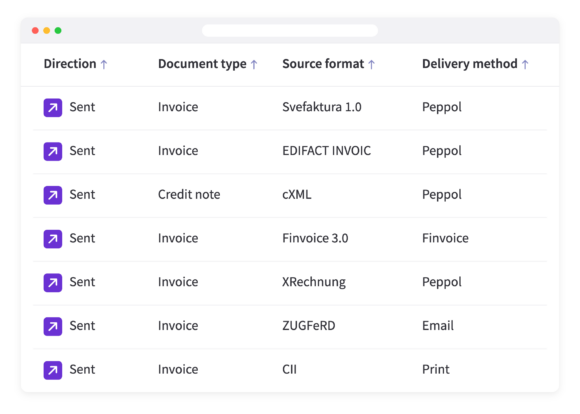
Qvalia’s Transaction API now accepts Svefaktura 1.0, EDIFACT, cXML, Finvoice, XRechnung, CII and ZUGFeRD, converts them to Peppol BIS Billing 3.0 and delivers them.
Qvalia is now connected to ELMA, the Norwegian Digitalisation Agency’s receiver register for the Norwegian market. This means we can register our customers in …
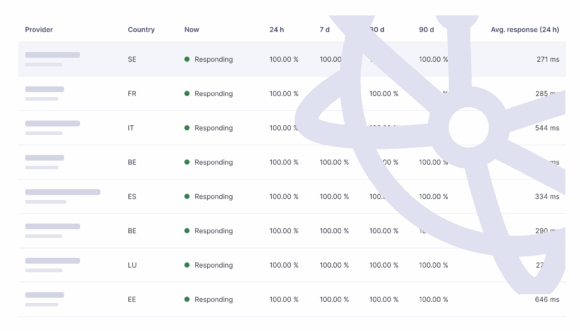
Qvalia’s new public monitor shows the status, measured uptime and response time of the AS4 endpoints of 132 Peppol Access Points in 34 countries.