Peppol is an international interoperability framework for exchanging structured e-invoices, orders and other business documents. It combines a governed network, standardized document specifications and common rules for certified service providers. Each organization connects through a Peppol service provider and can then exchange supported documents with other participants, whichever provider they use. OpenPeppol, an international non-profit association based in Belgium, governs the framework.
| Topic | In Peppol |
| Governance | OpenPeppol AISBL in Brussels, together with national Peppol Authorities |
| Exchange model | Four-corner model. Some national tax reporting systems add a fifth corner |
| Transport | AS4, signed and encrypted with OpenPeppol PKI certificates |
| Document formats | Peppol BIS and country-specific Peppol International (PINT) profiles, mostly in UBL XML |
| Addressing | Peppol ID: a scheme code plus an identifier, such as an organization number |
| Discovery | SML and SMP lookups, plus the public Peppol Directory |
What does Peppol stand for?
Peppol began in 2008 as an EU-funded pilot called Pan-European Public Procurement Online. When the project ended in 2012, its specifications and services passed to OpenPeppol. Today Peppol is the name of the interoperability framework rather than an acronym, and it is used for trade between businesses as well as for public procurement, in Europe and beyond. Read the history of the Peppol network.
How Peppol works: the four-corner model
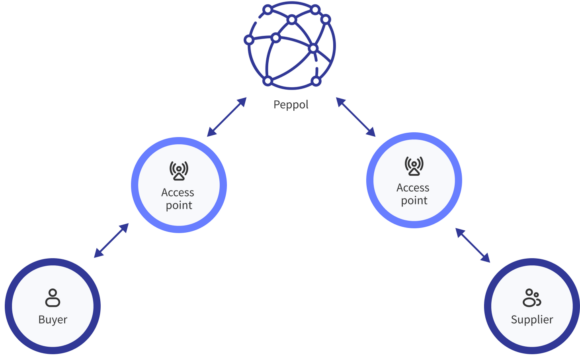
Sender and receiver never connect to each other directly. Each connects to its own Access Point, and the Access Points exchange the documents.
1. The sender creates the document
The supplier (corner 1) creates an invoice or other document in its ERP, finance system or e-invoicing app and passes it to its Access Point.
2. The sending Access Point validates and looks up the receiver
The sender’s Access Point (corner 2) checks the document against the Peppol specification. It then looks up the receiver’s Peppol ID in the Service Metadata Locator (SML), which points to the receiver’s Service Metadata Publisher (SMP). The SMP lists the document types the receiver accepts and the address of its Access Point. How SMP and SML work.
3. The Access Points exchange the document
The document travels between the two Access Points over AS4, signed and encrypted with certificates issued by OpenPeppol, and the receiving side confirms receipt.
4. The receiver gets the document
The receiver’s Access Point (corner 3) delivers the document to the buyer’s system (corner 4). Because discovery and transport are standardized, the two parties need no agreement or integration with each other, only one agreement each with their own service provider. What a Peppol Access Point does.
The five-corner model for tax reporting
Some countries add a fifth corner: the tax authority. In this model, called Decentralized Continuous Transaction Control and Exchange (DCTCE), service providers report tax data to the authority, while the invoice still travels between the businesses through their service providers, not through the tax authority. The UAE and Slovakia have adopted five-corner models for their national e-invoicing frameworks.
Who does what on the Peppol network
| Role | What it does |
| OpenPeppol | Governs the network and the specifications, and issues the PKI certificates that Access Points use |
| Peppol Authority | A national body that signs agreements with service providers and can add national requirements. Examples: the Swedish National Agency for Public Procurement (Upphandlingsmyndigheten), the NPa in the Netherlands and BOSA in Belgium |
| Service provider | Connects organizations to the network, verifies and registers their Peppol IDs, and operates or contracts an Access Point and SMP. What a Peppol Service Provider does |
| Access Point | The technical service that validates, sends and receives documents |
| SMP and SML | The SMP publishes each participant’s capabilities. The SML points senders to the right SMP |
| End user | The business or public body that sends and receives documents |
Peppol documents and formats
Peppol business documents are structured XML files that follow a Peppol Business Interoperability Specification (BIS) or a Peppol International (PINT) profile. Peppol BIS Billing 3.0, used for invoices and credit notes, complies with the European e-invoicing standard EN 16931 and is normally exchanged in UBL 2.1. PINT profiles adapt the Peppol specifications to national requirements in markets such as the UAE and Singapore.
- Invoices and credit notes, including self-billing
- Orders, order responses and order agreements
- Despatch advice
- Catalogues and punch out
- Invoice responses and message level responses
Peppol documentation and implementation guide
Specifications for every Peppol BIS document, participant identifiers, validation rules, release updates and Access Point status, collected in one technical reference for developers and implementation teams.

Peppol IDs: how organizations are addressed
Every organization that receives documents on Peppol is registered with a Peppol ID: a scheme code that identifies the type of identifier, followed by the identifier itself. A Swedish organization number is written 0007:5567321707, and a GLN 0088:1234567891234. You need a Peppol ID to receive documents. What a Peppol ID is and how to get one.
How to check if a company is on Peppol
Search for the company’s name or identifier in Qvalia’s Peppol ID search or in the Peppol Directory. If the company is registered, the result shows its Peppol ID. Publishing in the Peppol Directory is optional, so a missing result there does not always mean the company cannot receive documents. Your service provider can confirm with an SMP lookup.
Is Peppol mandatory?
Peppol is not a legal requirement in itself. Each country decides whether e-invoicing is mandatory and which formats and channels apply. Belgium has required structured e-invoices for nearly all domestic transactions between Belgian VAT-liable businesses since 1 January 2026. Peppol BIS over the Peppol network is the default, while other EN 16931-compliant channels are allowed by mutual agreement.
From 1 January 2027, Norwegian businesses with bookkeeping obligations must send structured e-invoices to other bookkeeping-obliged businesses that are registered to receive them. EHF and Peppol BIS Billing are approved formats, and transitional rules allow certain other structured formats until 2030. In the EU, public bodies must be able to receive e-invoices that comply with EN 16931, and many do so through Peppol. E-invoicing requirements by country.
Peppol compared with EDI and operator networks
Traditional EDI connects trading partners one by one, or through operators (VANs) that need roaming agreements with each other. Peppol replaces those bilateral set-ups with shared specifications and shared rules.
| Bilateral EDI or operator networks | Peppol | |
| Connection | One set-up per trading partner, or agreements between operators | One connection reaches every participant |
| Formats | Agreed per relationship | Common Peppol BIS specifications |
| Finding the receiver | Configured manually | Automatic lookup through SML and SMP |
| Rules | Commercial agreements | OpenPeppol and national Peppol Authorities |
[Video] The Peppol network basics
How to get started with Peppol
1. Choose a Peppol service provider
Pick a certified provider that supports the document types, markets and integration options you need.
2. Connect your system
Integrate your ERP or finance system by API or SFTP, use an existing connector, or start in a web app. Peppol API quick-start guide.
3. Register your Peppol ID
Your service provider verifies your organization and registers your Peppol ID, so others can send documents to you.
4. Test and go live
Exchange test documents with your trading partners, then switch to production. The effort depends on the document types, your source data and the integration method: a web app is quick to start with, while ERP and multi-entity integrations need technical planning and testing.
Peppol FAQ
What does Peppol stand for?
Peppol started as an acronym for Pan-European Public Procurement Online, the EU pilot project that created the network in 2008. Today it is the name of the framework, managed by OpenPeppol, and covers trade between businesses as well as public procurement.
Who runs Peppol?
OpenPeppol AISBL, a non-profit international association under Belgian law, develops and maintains the Peppol specifications. Its members include public bodies and private service providers. National Peppol Authorities oversee the service providers in their own countries.
Is Peppol only used in Europe?
No. Peppol started in Europe but is also used by public authorities and businesses in countries such as Australia, New Zealand, Singapore, Japan, Malaysia and the UAE, several of which use PINT profiles for local requirements.
What does Peppol cost?
Organizations do not pay OpenPeppol to use the network. They pay their service provider, and prices depend on the provider, the document volumes and the integration. Service providers pay OpenPeppol membership fees.
Can I send a PDF invoice over Peppol?
Not as the invoice itself. A Peppol invoice is a structured XML document that follows Peppol BIS, so a PDF must first be converted into that format. A PDF can be attached to a Peppol invoice as a supporting document, such as a time report.
What is the difference between Peppol and e-invoicing?
E-invoicing is the exchange of invoices in a structured format that systems can process automatically. Peppol is one way to exchange them: a network with common specifications that connects senders and receivers through certified service providers.
Further reading

Peppol Academy
Terms and terminology

Peppol ID lookup

Peppol and e-orders

The Peppol guide