Connection
REST API, SFTP or web app
API and sandbox access from the Medium plan
Validation
Before transmission
Peppol BIS, plus EN 16931 for invoices and credit notes
Availability
99.8% per month
Contractual, with service credits
One connection to the Peppol network
Connect your ERP, finance system, or software platform once and exchange supported business documents with organizations on Peppol. Qvalia handles participant discovery, certificates, secure transport, and network updates. For recipients outside Peppol, the same integration can use supported EDI, print, and B2C internet bank channels, depending on market and agreement.
How it works
What a Peppol Access Point does
A Peppol Access Point is a certified network service that sends and receives structured business documents for an organization. The sender and receiver each connect through an Access Point, and the two Access Points exchange the document in the Peppol four-corner model. Qvalia operates both an Access Point and a Service Metadata Publisher (SMP).

1. Validate
Each outgoing document is checked against the applicable Peppol BIS rules, and invoices and credit notes also against EN 16931. A document with errors is stopped before transmission.

2. Discover the recipient
The recipient’s Peppol ID is looked up in the Service Metadata Locator (SML) and the recipient’s SMP, which name the receiving Access Point and the document types it accepts.

3. Sign, encrypt, and send
The message is signed and encrypted with Qvalia’s Peppol PKI certificate and delivered to the receiving Access Point over AS4, the transport protocol used on the Peppol network.

4. Confirm delivery
The receiving Access Point returns a signed receipt. Qvalia records the delivery status so administrators and developers can trace each message.
Incoming documents follow the same path in reverse. Qvalia’s SMP publishes the document types your organization can receive, while the Access Point receives, verifies, and decrypts each message before delivery to your system or the Qvalia web app.
Connect through API, SFTP, or web app
Use the REST API or SFTP to exchange documents from your own system, or manage incoming and outgoing documents in the Qvalia web app. API and sandbox access are included from the Medium Connect plan.
From registration to go-live
We register your Peppol ID in Qvalia’s SMP and support testing and go-live. API and SFTP timelines depend on the document types, identifiers and system requirements in scope.
Choose how you connect
Use Qvalia’s Access Point directly, embed Peppol in your own product, or operate under your own Peppol Service Provider identity.
Businesses and enterprises
Connect your own systems
Send and receive Peppol documents from an ERP, finance, or procurement system for one or more legal entities.
Software companies
Embedded Peppol
Add Peppol to your product through the Partner API. Qvalia operates the Access Point and holds the Peppol Service Provider role for the service.
Service providers
Hosted Access Point
Hold your own Peppol Service Provider role, Access Point identity, and PKI certificate on infrastructure operated by Qvalia.
Supported Peppol documents
Qvalia’s Access Point supports Peppol specifications for billing, ordering, catalogs, despatch, and related response messages. Availability can depend on the selected plan, market, and integration scope.
Additional delivery channels
Qvalia can also support EDI, print, and B2C delivery through internet banks in selected markets. These are additional channels and are not Peppol document specifications.
- BIS Billing 3 invoice and credit note
- BIS Self-Billing Invoice and Credit Note
- PINT AE Billing
- BIS Invoice Response
- BIS Order Only
- BIS Ordering and Advanced Ordering
- BIS Order Agreement
- BIS Catalogue, with and without response
- BIS Despatch Advice
- BIS Punch Out
- BIS Message Level Response
Validation, delivery status, and traceability
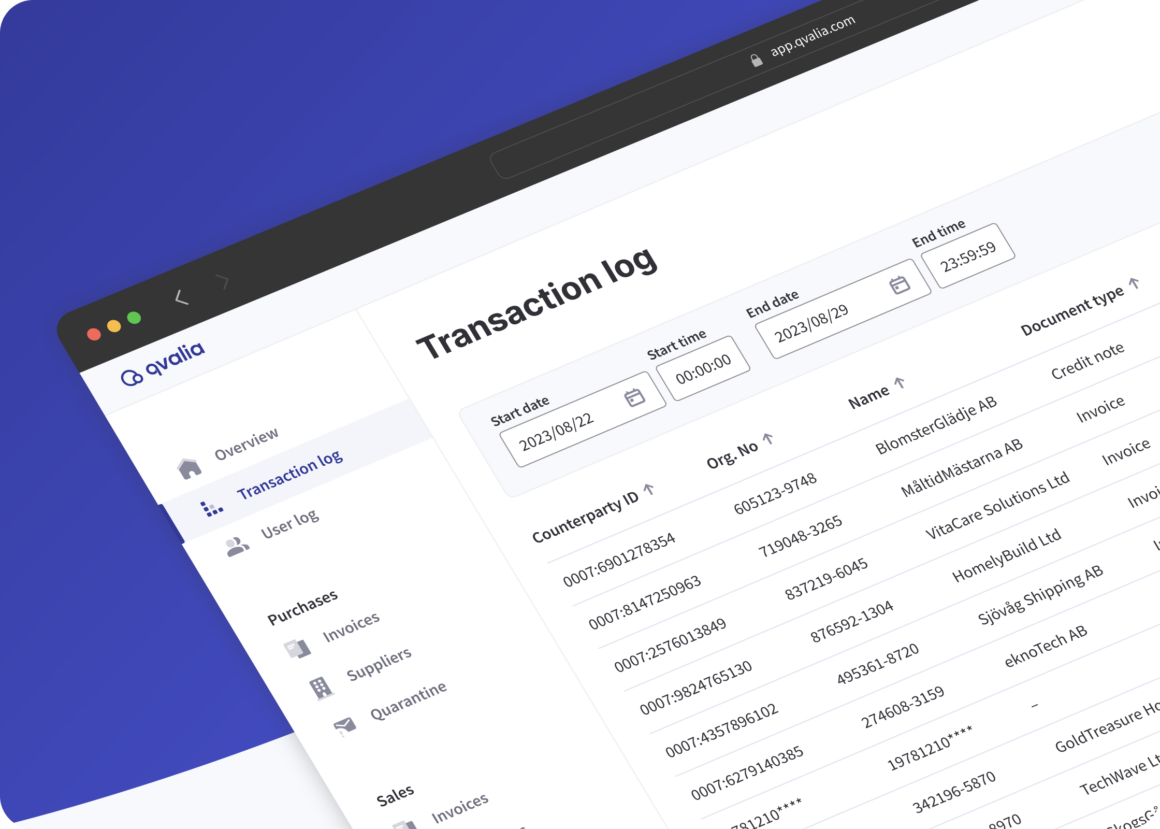
Qvalia records message status and delivery events. Administrators and developers can use the transaction and user logs to trace messages, investigate exceptions, and confirm delivery.
- Applicable Peppol BIS validation before outgoing transmission
- EN 16931 validation for supported invoices and credit notes
- Duplicate handling and error quarantine
- Message Level Response support
- AS4 transport with OpenPeppol PKI G3 certificates
- Transactional data stored in the EU


Peppol Access Point FAQ
What is a Peppol Access Point?
A Peppol Access Point is a certified network service that sends and receives structured business documents for an organization. It validates outgoing documents, discovers the recipient’s capabilities and Access Point, and exchanges messages securely over AS4. The sender and receiver each connect through their own Access Point.
What is the difference between a Peppol Access Point and an SMP?
The Access Point transports documents. The Service Metadata Publisher (SMP) publishes which document types an organization can receive and which Access Point serves it. Qvalia operates both services, so participant registration and document exchange are managed together. Read more about the SMP and SML.
Is Qvalia a certified Peppol Access Point and SMP provider?
Yes. OpenPeppol’s register lists Qvalia AB as AP Certified and SMP Certified in Sweden, under the Swedish Peppol Authority, the National Agency for Public Procurement (NAPP). The Slovak Financial Administration lists Qvalia AB as a certified delivery service provider (PA SK ID EFSK000023). See OpenPeppol’s register and the Slovak Financial Administration’s list.
Can Qvalia serve organizations in Finland?
Yes. Qvalia meets the Finnish Peppol Authority’s requirements for service providers with Finnish customers and has access to the national ACL service operated by the State Treasury. Read about the Finnish Peppol Authority.
Do I need a Peppol Access Point to send Peppol invoices?
Yes. Peppol documents are sent and received through certified Access Points. Most organizations connect through a Peppol Service Provider such as Qvalia rather than operating the network infrastructure themselves.
Can I run my own Peppol Access Point?
Yes, if your organization holds the Peppol Service Provider role. With Hosted Access Point, you hold the role, Access Point identity, PKI certificate, and governance obligations, while Qvalia operates the agreed infrastructure. Approval remains with OpenPeppol or the relevant Peppol Authority.
Can software companies offer Peppol to their customers through Qvalia?
Yes. With Embedded Peppol, your product connects to Qvalia’s Access Point through the Partner API. With the White-label platform, you offer Qvalia’s application under your own brand. Qvalia holds the Peppol Service Provider role for both models. Compare the delivery models.
What happens if a document fails validation?
An outgoing document that fails the applicable Peppol BIS validation is stopped before it reaches the network. Supported invoices and credit notes are also checked against applicable EN 16931 validation rules. The validation errors are shown so the document can be corrected and sent again.
What does Qvalia’s Peppol Access Point service cost?
Public Connect plans range from €9 to €899 per month and include Peppol ID registration. API and sandbox access are included from the Medium plan. Enterprise and partner pricing depends on the required setup. Compare current plans and pricing.
What availability does Qvalia commit to?
Qvalia’s contractual availability is 99.8% per month, with service credits under the master subscription agreement. Current operational status is published on the system status page, and the Access Point is included in Qvalia’s public Access Point monitor.
Discuss your setup
Tell us which systems, markets, document types. We will recommend a suitable plan or delivery model and outline the next steps.


