
Peppol started in 2008 as a European Commission pilot for cross-border public procurement. Today it is an international framework for exchanging e-invoices, orders and other business documents, used by public bodies and businesses in Europe, Asia-Pacific and the Middle East. This article follows how it got there: the original project, the handover to OpenPeppol, the technical changes that turned it into a general business network, and the national mandates now built on it.
For how the network works today, see What is Peppol?
Why Peppol was created
In the mid-2000s, electronic public procurement in Europe was fragmented. Member states had their own e-tendering platforms, electronic signature schemes and invoice formats, so a supplier in one country could rarely bid for or invoice a public contract in another without adapting to local systems. The European Commission funded PEPPOL (Pan-European Public Procurement Online) to show that cross-border e-procurement could work on shared, open specifications.
A paper presented at the Wirtschaftsinformatik conference in 2009 described the core challenge as interoperability on three levels: organizational (common processes and a pragmatic handling of legal differences), semantic (standardized business documents) and technical (standardized transport and electronic signatures). The authors argued that a Europe-wide solution had to be based on open standards and build on existing national infrastructure (Sonntagbauer and Bodiroza, 2009).
The PEPPOL project, 2008 to 2012
PEPPOL started on 1 May 2008 as a large-scale pilot under the EU’s Competitiveness and Innovation Programme (CIP ICT Policy Support Programme). It was coordinated by the Norwegian Agency for Public Management and eGovernment (Difi), and its €30.8 million budget was funded jointly by the European Commission and the consortium members. The consortium grew during the project and ended up with 18 partners from 11 or 12 European countries, depending on the source.
The project covered the procurement chain both before and after the contract award:
- eSignature: validating electronic signatures issued in other countries
- Virtual Company Dossier (VCD): cross-border evidence of a supplier’s qualifications
- eCatalogue: exchanging product catalogs between buyers and suppliers
- eOrdering: electronic purchase orders
- eInvoicing: electronic invoices between suppliers and public buyers
- A common transport infrastructure connecting the national solutions
Some of the hardest problems were legal and organizational rather than technical. Electronic signatures are a good example. Many member states required qualified or advanced signatures in e-tendering, so a bid signed in one country had to be verifiable in another. PEPPOL addressed this with signature validation services instead of a single signature scheme, an approach described in a 2012 paper on the project’s four years of eSignature work (Ølnes, 2012). After an extension, the project formally ended on 31 August 2012.
OpenPeppol takes over
To keep the specifications and the network running after the EU funding ended, the results were handed over to a new organization. OpenPeppol AISBL, an international non-profit association under Belgian law, has been operational since 1 September 2012 as the member-driven organization that maintains and governs the Peppol specifications, agreements and governance framework.
OpenPeppol started with 5 members from 5 countries. By October 2019 it had 375 members in 34 countries. In July 2025 it reported members in 44 countries, Peppol Authorities in 23 countries and Peppol business documents exchanged in 65 countries.
The name changed character along the way. PEPPOL began as an acronym for the pilot. OpenPeppol now describes Peppol simply as the name of its interoperability framework, and the network is used for trade between businesses as well as for public procurement.
How OpenPeppol is governed
OpenPeppol is member-driven. Key elements of its governance structure include:
- General Assembly: the highest authority, which meets yearly, elects officers and approves plans and budgets
- Managing Committee: the Secretary General as chair plus six members elected by the General Assembly, two from each stakeholder community
- Secretary General and Operating Office: day-to-day management, finance, compliance and technical support
- Coordinating Committee: the leaders of all communities, who align work across them
- Communities: three stakeholder communities (End Users, Service Providers and Peppol Authorities) and five domain communities (Peppol Network, Pre-Award, Post-Award, Continuous Transaction Controls and Logistics)
- Election Committee: ensures there are qualified candidates for elected positions
Each participating country has a Peppol Authority, a government body that signs agreements with the service providers in its country and can add national requirements. In Sweden, the role is held by the National Agency for Public Procurement (Upphandlingsmyndigheten).
From public procurement to a general business network
Three changes between 2014 and 2023 turned Peppol from a procurement pilot into infrastructure that businesses use for everyday trade.
A European standard for e-invoices
Directive 2014/55/EU required public authorities in the EU to be able to receive and process electronic invoices that comply with a European standard, which CEN published as EN 16931 in 2017. Central government bodies had to be able to do so by 18 April 2019, and sub-central contracting authorities by 18 April 2020 at the latest. EN 16931 defines the semantic data model of an invoice. Peppol BIS Billing 3.0 is a Core Invoice Usage Specification (CIUS) of the standard that makes the model implementable on the Peppol network, so a valid Peppol invoice also follows EN 16931. It became available on 27 February 2018 and mandatory on the network on 18 April 2019, and it is maintained through regular releases. See the current Peppol BIS Billing documentation for the applicable version.
New transport protocols
The pilot’s first transport protocol, START, was replaced by AS2 in the years after the project, and later by AS4, the same messaging standard used by the EU’s eDelivery building block. AS4 became mandatory between Peppol Access Points on 1 February 2020, according to OpenPeppol’s migration plan. The change shows how Peppol keeps the business document specifications separate from the messaging layer that transports them.
International specifications
As countries outside Europe joined, Peppol needed a way to support local rules on a common core. Peppol International (PINT) provides a common international core for invoice specifications, with jurisdiction-specific profiles where local tax and regulatory requirements differ, such as PINT SG for Singapore, PINT JP for Japan and PINT AE for the UAE. The International Observatory on eInvoicing at Politecnico di Milano dates the launch of the PINT standard to July 2023.
Peppol goes global
The first Peppol Authorities outside Europe were set up in Asia-Pacific:
- Singapore: IMDA became Singapore’s Peppol Authority in May 2018, the first in Asia, and launched a nationwide e-invoicing network on 9 January 2019.
- Australia and New Zealand: the two countries announced a joint plan to adopt Peppol in February 2019, with the Australian Taxation Office and New Zealand’s Ministry of Business, Innovation and Employment as Peppol Authorities.
- Japan: the government set up the Digital Agency and a Japanese Peppol Authority in September 2021 and developed JP PINT ahead of the qualified invoice system, which started on 1 October 2023. That system introduced requirements for qualified invoices for consumption tax purposes but did not create a general obligation to exchange invoices electronically.
- France: the tax administration (DGFiP) established a Peppol Authority on 8 July 2025.
Network size has grown with the mandates. In April 2024, before Belgium’s B2B mandate took effect, OpenPeppol reported 1,016,364 registered receivers in the network. The figure counts registered receiving participants, not unique companies.
How the exchange model evolved
Two corners
Many traditional EDI arrangements connected trading partners through bilateral agreements and partner-specific configurations. Each new partner needed its own setup, so costs grew with every connection.
Three corners
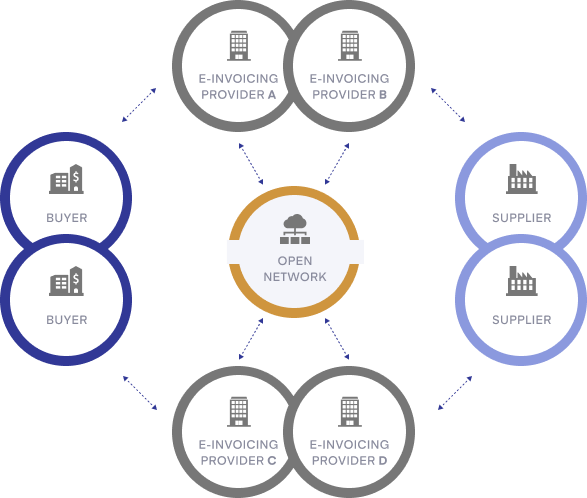
Operators (VANs) then acted as intermediaries. This works when both parties use the same operator, but across operators it requires roaming agreements, and international trading partners rarely share one.
Four corners
Peppol uses a four-corner model: the sender, the sender’s Access Point, the receiver’s Access Point and the receiver. The sending Access Point uses SML and SMP lookups to find the receiver’s Access Point and the document types the receiver accepts, so the two parties need neither a shared provider nor a bilateral connection.
Five corners
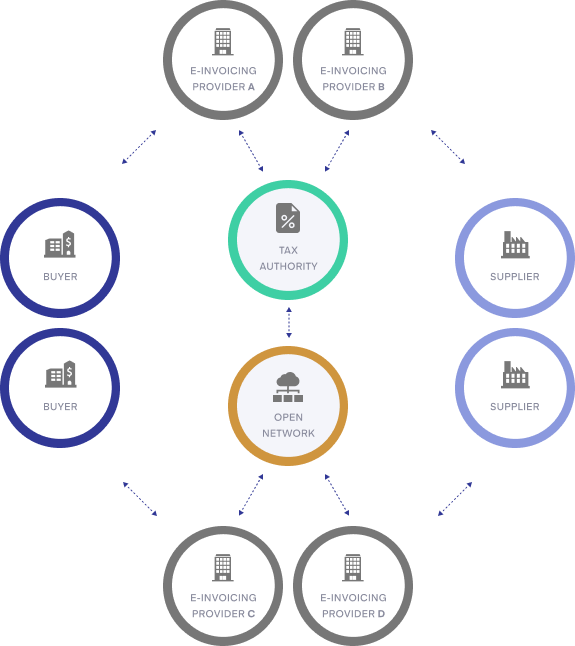
Some countries add a fifth corner: the tax authority. In this decentralized model, known as DCTCE (Decentralized Continuous Transaction Control and Exchange), the service providers report tax data to the authority while the invoice still moves between the businesses’ Access Points, so the authority does not stop or approve each invoice. In the UAE, Ministerial Decision No. 244 of 2025 set a pilot and voluntary phase from 1 July 2026 and requires large businesses to implement by 1 January 2027. Slovakia starts mandatory domestic B2B e-invoicing with five-corner reporting on 1 January 2027, with intra-EU transactions planned to follow from 1 July 2030.
Mandates built on Peppol
Peppol itself is not a legal requirement, but a growing number of national mandates rely on it. Belgium has required structured e-invoices for nearly all domestic transactions between VAT-liable businesses since 1 January 2026, with Peppol as the default channel. From 1 January 2027, Norwegian businesses with bookkeeping obligations must issue electronic invoices to other bookkeeping-obliged businesses that are registered to receive them, and from 1 January 2030 all of them must be able to receive e-invoices. EHF and Peppol BIS Billing are approved formats, and a PDF does not meet the requirement when the buyer can receive e-invoices. E-invoicing requirements by country.
Peppol timeline
| Year | Milestone |
| 2008 | The PEPPOL pilot starts on 1 May under the EU’s CIP ICT Policy Support Programme, coordinated by Difi in Norway |
| 2012 | The project ends on 31 August. OpenPeppol AISBL takes over on 1 September |
| 2014 | Directive 2014/55/EU on e-invoicing in public procurement |
| 2017 | CEN publishes the European e-invoicing standard EN 16931 |
| 2018 | Peppol BIS Billing 3.0 released (27 February). IMDA becomes Singapore’s Peppol Authority (May) |
| 2019 | Singapore launches its nationwide e-invoicing network (9 January). Australia and New Zealand announce adoption (February). BIS Billing 3.0 mandatory (18 April) |
| 2020 | AS4 mandatory between Peppol Access Points (1 February) |
| 2021 | Japan sets up the Digital Agency and a Peppol Authority (September) |
| 2023 | PINT launched (July). Japan’s qualified invoice system starts (1 October) |
| 2025 | France’s DGFiP establishes a Peppol Authority (8 July). Peppol Authorities in 23 countries |
| 2026 | Belgium’s B2B e-invoicing mandate starts (1 January). UAE pilot and voluntary phase (1 July) |
| 2027 | Norway’s B2B requirement and Slovakia’s mandate start (1 January). Large UAE businesses must implement (1 January) |
| 2030 | Norwegian businesses with bookkeeping obligations must be able to receive e-invoices (1 January). Slovakia plans to extend e-invoicing to intra-EU transactions (1 July) |
Get started with Peppol
Qvalia is a certified Peppol Access Point and SMP provider. We connect businesses and software platforms to the network, register Peppol IDs and handle delivery. Read how we work as your Peppol Service Provider or the Peppol documentation and implementation guide.
Sources
- European Commission, CIP ICT PSP project portfolio: PEPPOL
- Sonntagbauer, P. and Bodiroza, M. (2009). Pan European Public e-Procurement Online (PEPPOL): The challenges of implementing a European wide solution. Wirtschaftsinformatik Proceedings 2009
- Ølnes, J. (2012). PEPPOL: Experience from four years work on eSignature interoperability. ISSE 2012, Springer Vieweg
- OpenPeppol (2019). PEPPOL for newcomers
- OpenPeppol: About and Organisation
- Directive 2014/55/EU on electronic invoicing in public procurement
- OpenPeppol: Peppol BIS Billing 3.0 migration plan and AS2 to AS4 migration
- OpenPeppol: Peppol case study, IMDA Singapore
- Technology Decisions (15 November 2019). ATO named Australian PEPPOL authority
- Digital Agency Japan (2022). Overview of the Japanese roll-out
- OpenPeppol (9 July 2025). OpenPeppol welcomes the Peppol Authority for France
- OpenPeppol (15 May 2024). Peppol presentation to the EU eDelivery community
- International Observatory on eInvoicing, Politecnico di Milano (2025). The global shift to eInvoicing
Related articles
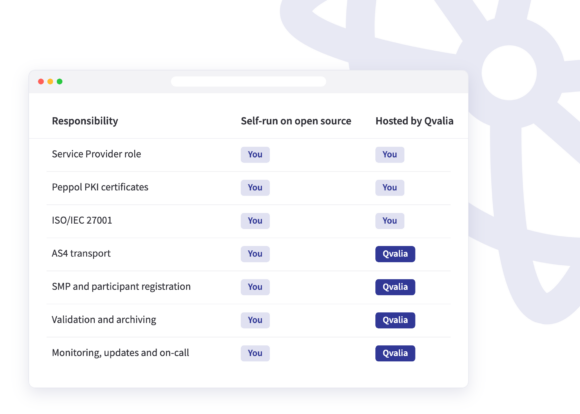
How to set up your own Peppol Access Point: run it yourself on open-source software such as Oxalis or phase4, or outsource operations to a Hosted Access Point. What each route covers, the 2027 network requirements and national accreditation.
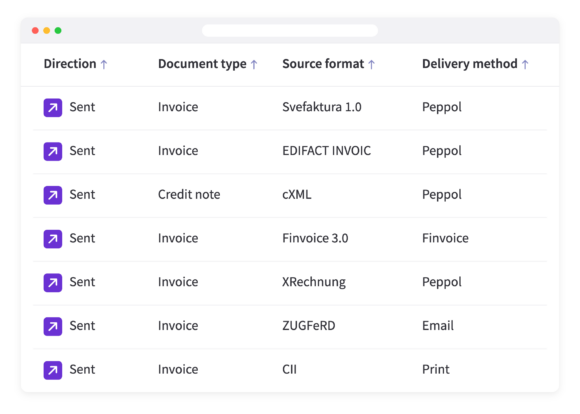
Qvalia’s Transaction API now accepts Svefaktura 1.0, EDIFACT, cXML, Finvoice, XRechnung, CII and ZUGFeRD, converts them to Peppol BIS Billing 3.0 and delivers them.

Qvalia is now connected to ELMA, the Norwegian Digitalisation Agency’s receiver register for the Norwegian market. This means we can register our customers in …