Qvalia’s Peppol partners can choose how to structure Peppol access, accounts, and Peppol ID registrations for end-users. There are two main configuration models:
- Consolidated account setup
- Multi-tenant accounts setup
As an option, partners can use Qvalia’s white-label services to embed full UI for business message management into most frontend environments.
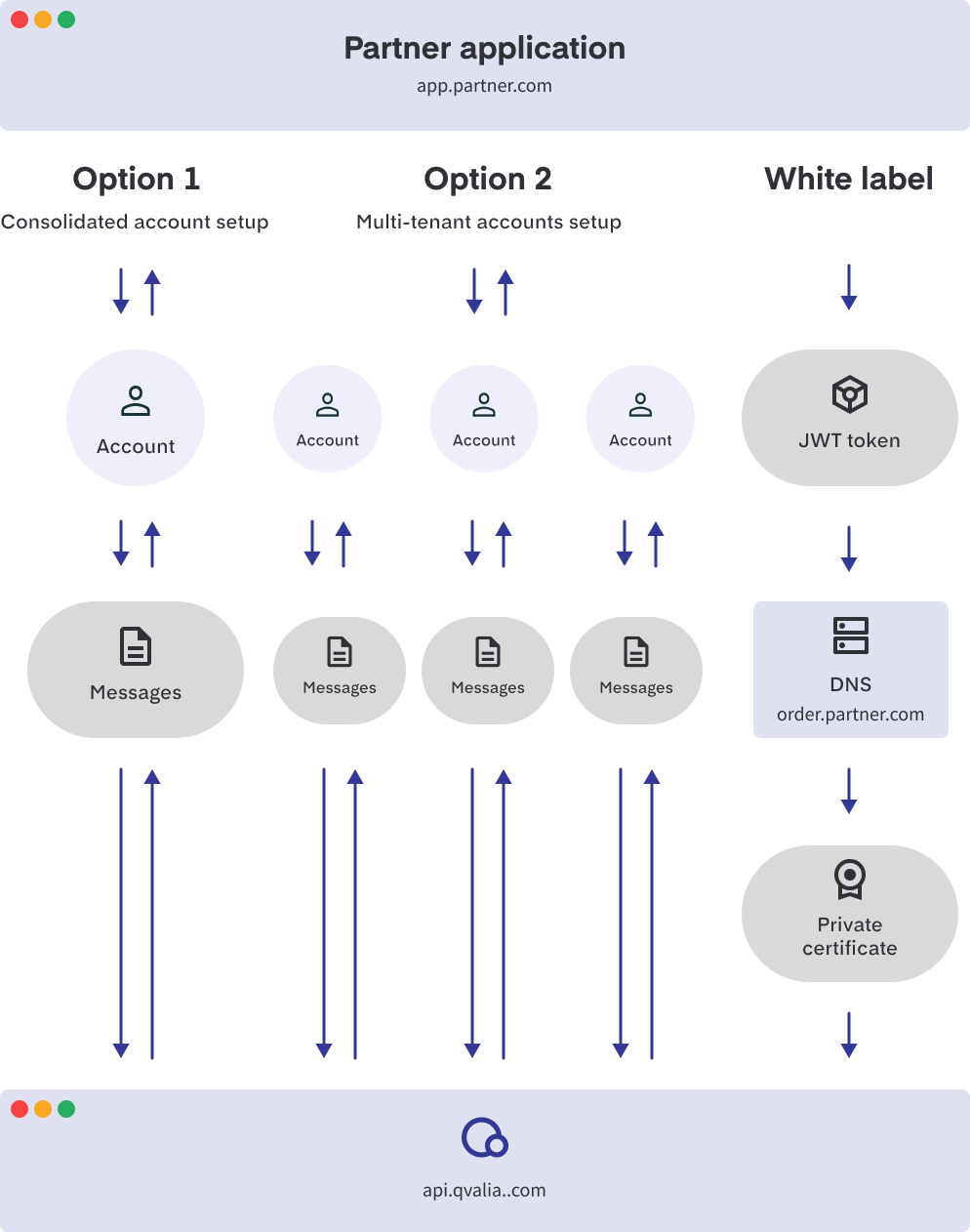
Option 1: Consolidated account setup
In a consolidated setup:
- The partner operates a single Qvalia account.
- Each end customer is identified by one or more Peppol IDs linked to that account.
- Message traffic is logically separated by Peppol ID but shares the same underlying account and infrastructure.
Typical advantages:
- Simplified onboarding and configuration
- Centralised monitoring and transaction reporting
- Efficient for large numbers of smaller customers
- Single integration between the partner platform and Qvalia
When to consider consolidated accounts:
- You manage many SME customers with similar needs.
- You want unified operational monitoring and reporting.
- You prefer minimal account administration.
Option 2: Multi-tenant accounts setup
In a multi-tenant setup:
- Each end customer has their own Qvalia account.
- Each account has its own Peppol ID(s), configuration, and logs.
- The partner manages multiple accounts via the Partner API.
Typical advantages:
- Strong separation between customers
- Individual configuration, limits, and reporting per customer
- Easier alignment with customers who require their own account and credentials
When to consider multi-tenant accounts:
- You serve larger enterprises or public-sector customers.
- Customers expect a dedicated account and audit trail.
- You need per-customer configuration or commercial terms.
Choosing between the models
Partners can mix both patterns if needed. As general guidance:
- Use consolidated accounts for high-volume, standardised offerings.
- Use multi-tenant accounts for strategic or compliance-sensitive customers.
We can help you choose the right model. Contact us to learn more.