- Mikä on Peppol?
- Transaction methods compared
- How the Peppol network works
- Background
- The building blocks of Peppol
- Pääsy Peppoliin
- Benefits of Peppol
- Peppol BIS Billing
- Peppol BIS Billing Luottoilmoitus
- Peppol BIS Invoice Response
- Peppol BIS Order Only
- Peppol BIS Ordering
- Peppol BIS Advanced Ordering
- Peppol BIS Catalogue With/Without Response
- Peppol BIS Despatch Advice
- Peppol BIS Punch Out
- Peppol BIS Order Agreement
- Peppol BIS Message Level Response
- Data quality and structured data
- How to implement Peppol
- 1. Define your ideal process — start with the end in mind
- 2. Evaluation — get into the specifics of your processes
- 3. Technical requirements — get into the specifics of your tech
- 4. Select a Peppol Access Point — choose a service provider with care
- 5. Roadmap implementation — plan the integration
- 6. Onboarding — finalize integration and onboard users
- Usein kysytyt kysymykset

An introduction to the Peppol network, electronic business messaging and how to improve transactional processes.
Last updated September 2026.
Mikä on Peppol?
Peppol is an open, standardized network for exchanging electronic business documents such as e-invoices and e-orders. Any organization can connect through a certified access point and reach every other participant worldwide — without bilateral agreements or custom setups. The network is governed by the non-profit organization OpenPeppol.
Evolving business transactions
Invoicing has transformed remarkably from its traditional paper-based processes to the sophisticated digital networks we see today.
Historically, invoices were manually created, sent, and processed, which was not only time-consuming but also prone to errors. To this day, the vast majority are still paper-based. As businesses sought efficiency and accuracy, the shift towards electronic invoicing — e-invoicing — began.
The evolution of electronic business transactions
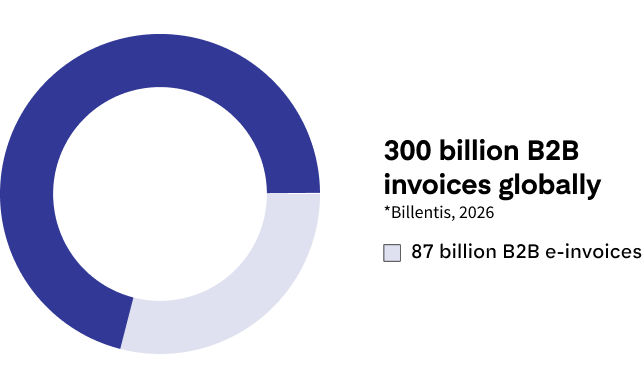
Furthermore, this development has paved the way for increased digitization of the transactional landscape. A growing number of business messages exchanged between companies are now electronic. Orders, responses, and delivery messages are just a few examples. The impact is vast.
1st generation tech:
Distributing documents electronically with EDI
In the late 20th century, the advent of electronic data interchange (EDI) marked a significant leap in how businesses communicated financial transactions. The first EDI message was a shipping manifest sent in 1965 by the Holland-America Line using telex. FTP, The File Transfer Protocol, was introduced in the early 1970s and enabled easy file transfer via the Internet. In the 80s, large retail and car manufacturing companies started to induce their suppliers to use EDI. The adoption of electronic business messages has increased continuously ever since.
2nd generation tech:
VAN operators act as intermediaries
A Value-Added Network (VAN) is a hosted service that provides companies with capabilities to exchange business messages electronically, data interchange (EDI) documents. VANs act as intermediaries that handle the transmission of data in various formats across different communication protocols. They could offer additional services such as message encryption, transaction auditing, and management reporting, which enhance the data exchange process. Historically, VANs were pivotal in enabling EDI between businesses that may not have direct connections, thus facilitating smoother, more efficient B2B exchange. However, the costs associated with VAN services, due for example to the lack of international standardization and the need for testing and data transformation between formats, were restrictive. It led to the emergence of a more flexible, internet-based solution: the Peppol network.
3rd generation tech:
Peppol network
Both direct EDI and VANs face challenges with flexibility and cost, particularly for small to medium-sized enterprises (SMEs). This has led to the rise of the more modern and open network Peppol — originally an EU project named “Pan-European Public Procurement On-Line,” today a standalone global brand — which offers a standardized, open network that any organization can join. Peppol simplifies the exchange of electronic documents across different systems and geographies without the need for custom setups for each new partner, making it more accessible and reducing overall transaction costs.
About Peppol
The network is governed by OpenPeppol, a non-profit organization that maintains standards and ensures that they meet user needs and tech advancements.
Unlike traditional EDI and value-added networks (VANs) that typically require specific, often expensive setup for each trading connection, Peppol is an open network that allows entities across different countries to exchange electronic documents over its standardized network. It simplifies the process by providing a uniform set of rules and a common legal framework, making it easier, faster, and more cost-effective for organizations to manage their invoicing and other business communications.
Originating in the EU to simplify procurement, Peppol has expanded globally, with registered participants in over 110 countries — including Japan, Malaysia, Singapore, Australia, New Zealand, and the UAE.
For businesses engaged in public procurement, particularly in Europe, Peppol compliance is becoming essential. Legislation on e-invoicing and digital tax reporting is strengthening Peppol’s role further: the EU’s VAT in the Digital Age (ViDA) package, adopted in March 2025, mandates structured e-invoicing and digital reporting for intra-EU B2B transactions from 2030, and national B2B mandates are already in force or imminent in countries such as Germany, Belgium, Poland, and France.
The emergence of the Peppol network marks a significant evolution in the way businesses handle their invoicing and procurement processes, setting a new standard for digital transactions that is likely to shape the future of commerce. As we move forward, adopting networks like Peppol will be crucial for companies looking to stay competitive in an increasingly digital global market.
Transaction method cheat-sheet
The three main methods to exchange electronic business messages.
Direct connection with EDI
- Direct EDI, or point-to-point EDI, enables business document exchanges directly between two trading partners’ IT systems without third-party involvement.
- Each partner must establish and maintain individual connections, which can be complex and costly for companies with multiple partners.
- Direct EDI offers quicker data exchanges as information travels directly from sender to receiver, bypassing third-party services.
- It requires mutual agreement on data formats and protocols, and each connection may require unique setup and maintenance, reducing flexibility.
Simplified EDI connection with VAN
- VANs serve as intermediaries for multiple businesses to exchange data, including EDI documents.
- Using a VAN, companies avoid maintaining multiple direct connections, simplifying communication and reducing costs.
- VANs enhance value by providing secure data transmission, translation, transaction tracking, archiving, and other services.
- The primary drawbacks of VANs are ongoing costs from fees and potential delays in data transmission due to intermediary processing.
The open business network Peppol
- Peppol standardizes formats for documents like invoices and purchase orders, improving interoperability and reducing complexity.
- Peppol provides the exchange infrastructure with one common participant catalog.
- Peppol allows any organization to join, lowering entry barriers for smaller businesses and boosting competition.
- Peppol uses certified service providers known as access points to ensure secure, reliable document transmission. Just connect and get started.

Transaction methods compared
Going from manual to digital
Embracing digital transformation in all financial processes begins with enhancing data quality.
Switching from manual processes to e-invoicing and e-orders can initially seem challenging, requiring significant IT expertise and financial resources. However, adopting Peppol can simplify this transition significantly.
This guide will help you evaluate your current accounts payable (AP) and accounts receivable (AR) processes, identify areas for improvement, and understand how Peppol can streamline your operations.
Transaction methods
What’s your process for managing and exchanging transactions? Let’s deep-dive into the most common practices.
1. Paper and PDF-based manual process
No digitization has been made, and it might have worked fine for you. With just a few suppliers and customers per month, adopting digital solutions hasn’t been worth the investment besides handling PDFs. However, the method comes with costs and risks. Typical pain points include manual, monotonous process steps, manual errors, and insufficient analytics capabilities. The process is costly for both suppliers and buyers.
Pros
- No maintenance or updates
Cons
- Very challenging to scale
- Increasingly non-compliant
- High scaling costs
Assessment: Do I have time to enter my invoices into my ERP manually? Does the process create errors? What is the regulatory landscape?
Improvement potential: Signing up for a web-based e-invoice management solution with Peppol network access is the easiest and least expensive way to use e-invoices and other electronic business messages.
2. PDF-based with internal scanning
You are using optical character recognition (OCR) software to interpret supplier invoice information, so you don’t need to enter it into your accounting software or workflow manually. A decade ago, OCR was a state-of-the-art technology that was more convenient than handling paper invoices. It is now regarded as a legacy tech with significant downsides compared to modern alternatives.
The main challenge is that OCR can’t perfectly interpret the information from PDFs. Image files like PDFs lack the structured normalized data that e-invoices and other electronic business messages contain. Missing or misinterpreted information is a key source of errors in the financial process, which requires ongoing manual attention for quality assurance. Often, only header data is captured, and scanned invoices must be transferred to the ERP.
Pros
- Makes paper and PDF-based processes more efficient
Cons
- Time consuming
- High software costs
- Continuous quality risks
Assessment: Do I have a sufficient process to monitor and ensure quality? Is my process scalable? What is the cost compared to electronic business messages?
Improvement potential: E-invoices and other electronic business messages are the natural progression from analog formats.
3. PDF-based with scanning service provider
You rely on PDFs but use a service provider to scan paper formats and do the OCR. It makes internal processes more efficient and automatically scales according to your transaction volumes.
Regardless of whether the work is done outsourced or in-house, OCR has the same technology issues. PDFs do not provide the structured, normalized data found in e-invoices and other electronic business messages. This regularly leads to errors due to missing or incorrectly interpreted information, necessitating continuous manual oversight to ensure data quality. Furthermore, the dependence on an external part for manual work in critical processes exposes you to additional risks like missing invoices and late deliveries. High costs per transaction and support make, in general, these services expensive.
Pros
- Scalable solution
Cons
- High costs
- Outdated technology
- Continuous quality risks
- Continuous service delivery risks
Assessment: Does the service provider have a sufficient process to monitor and ensure quality? Do I have a sufficient process to monitor and ensure quality? Is my process scalable? What is the cost compared to electronic business messages?
Improvement potential: E-invoices and other electronic business messages are the natural progression from analog formats.
4. Point-to-point EDI managed inhouse
Electronic Data Interchange (EDI) is the collective term for establishing and maintaining unique connections between two business partners. Once set up as point-to-point, the connection is hardcoded and robust. The practice uses fully digital formats, lossless transmission, and machine-readable normalized data.
Connecting new suppliers is a substantial IT undertaking. Custom conversion and mapping between data formats efforts alone demand 40-80 hours of work. Any modifications to the ERP system on either side often necessitate a complete redo. This setup also requires continuous maintenance, demanding a high level of internal IT expertise.
Pros
- Suitable for small networks with very high transaction volumes
Cons
- High implementation cost
- Extensive IT expertise needed
- Vulnerable to changes
- No scalability
Improvement potential: The Peppol network enables the next-generation technology for EDI. Its open participant directory and standardized Peppol BIS formats radically simplify connections and maintenance.
5. Point-to-point EDI managed by service provider
Using a solution provider for point-to-point EDI connections is convenient compared to setting up and maintaining connections with internal IT resources. The service provider takes care of all technical aspects, integrations, and file transformations which makes handling easy, but the costs for implementation and support, as well as fixed and volume-based transaction fees, are often considerable.
Pros
- Suitable for small networks with very high transaction volumes
Cons
- High costs
- 3rd party dependency
Improvement potential: The Peppol network enables a competitive and modern alternative to solutions from EDI service providers. The open participant directory and standardized formats offer an infrastructure for businesses of all sizes. The ease of use makes business messaging via Peppol accessible for smaller companies, which supports the digitization throughout the supply chain.
6. VAN service providers
VAN service providers, also called operators, provide a more convenient solution compared to business messaging using point-to-point EDI by enabling access to the Value-Added Network (VAN). By using a four-corner model, VAN offers a connection to the customer’s ERP, and/or a complementary web-based portal, and maintains connections and interoperability with other VAN operators. Incoming business messages are transformed to the customer’s inhouse format, the so-called canonical format. The VAN operator makes the necessary transformations for outgoing messages.
VAN operators act as gatekeepers to a semi-open network, which contributes to high transaction costs. One message includes fees for the sending party, the receiving party, and for transformations in both ends.
Traceability is also a limiting factor, as VAN operators only can provide information about processed messages. Support is needed every time a user wants to investigate if a sent business message has been received.
Pros
- Simplified EDI
- Greater reach
Cons
- High cost
- Gatekeeper position
- Lack of traceability
Improvement potential: The Peppol network enables a competitive and modern alternative to VAN. The open participant directory and standardized formats offer an infrastructure for businesses of all sizes. The ease of use makes business messaging via Peppol accessible for smaller companies, which supports the digitization throughout the supply chain.
7. Peppol network via service providers
Peppol is a game-changer in electronic business messaging. Instead of building point-to-point connections or routing through a VAN, companies connect once to a certified access point and can immediately exchange e-invoices, e-orders, catalogues, despatch advice, and more with any of the 4.4 million+ registered participants across 116 countries (Peppol network, June 2026). One setup. One standard. Global reach.
Standardization radically simplifies integration and reduces costs throughout the supply chain. Peppol is well established across Europe — where it underpins mandatory e-invoicing in Belgium, Germany, France, and the Nordic countries — and is expanding rapidly in Asia-Pacific (Australia, New Zealand, Singapore, Malaysia, Japan) and beyond.
Pros
- Most cost-efficient method
- International compliance
- Highly scalable
- Transparent participant directory
- Continuous development
Cons
- Global coverage still growing
- Some complex legacy EDI formats not yet covered
What is data transformation?
Transformation is often necessary to make business messages such as e-invoices compatible between ERPs and other systems. The process involves conversion and mapping of the original file.
- Conversion refers to the process of changing the format of data from its original form into another. For example, converting an XML-based invoice to a JSON format.
- Mapping involves aligning data fields from the source format to the corresponding fields in the target format. For example, changing field names or structure.
Transaction process cheat-sheet
| Method | Pros | Cons | Key considerations |
|---|---|---|---|
| 1. Paper and PDF-based manual process | No maintenance or updates required. | Difficult to scale, non-compliant with modern regulations, high scaling costs. | Time-consuming manual entry, prone to errors, limited analytical capabilities. |
| 2. PDF-based with internal scanning (OCR) | Improves efficiency over manual processes. | Time-consuming, high software costs, continuous quality risks. | Inaccuracy in data capture, requires significant manual quality assurance. |
| 3. PDF-based with scanning service provider | Scalable solution. | High costs, reliance on outdated technology, continuous service and quality risks. | Dependency on external parties, ongoing manual oversight needed. |
| 4. Point-to-point EDI managed inhouse | Suitable for small networks with high transaction volumes. | High implementation and maintenance costs, requires extensive IT expertise, non-scalable. | Significant IT resources required, vulnerable to any changes in system or partners. |
| 5. Point-to-point EDI managed by service provider | Handles technical setup and maintenance. | High costs, dependency on third-party service providers. | May be restrictive and expensive for businesses with fluctuating transaction volumes. |
| 6. VAN service providers | Simplified EDI, greater reach within the network. | High costs, acts as gatekeeper, limited traceability. | Necessary for businesses needing broad network access but costly and less transparent. |
| 7. Peppol network via service providers | Cost-efficient, compliant internationally, highly scalable, transparent participant directory. | May not support complex messages fully. | Offers a standardized and simplified system, increasingly required by national e-invoicing mandates. |
How the Peppol network works
Business messaging networks: the basics
For decades, operator networks have been the dominant infrastructure for the electronic exchange of e-invoices and other business documents between businesses and organizations.
These networks connect various service providers, known as e-invoice operators or Value-Added Network (VAN) services, facilitating access to business messaging. We call it the closed network setup.

Suljettu verkkoasetus
The traditional closed network setup has been somewhat problematic, creating barriers to faster adoption of e-invoicing. Typically, companies have had to navigate through these steps:
- Both the sender and receiver of the business message must have separate agreements with a VAN operator.
- The sender’s and receiver’s operators must have an interoperability agreement to process their e-invoices.
- The operators must set up, test, and maintain technical configurations to enable e-invoices and other business messages to be processed.
- Usein tarvitaan vielä formaattimuunnos, jotta verkkolasku voidaan käsitellä edelleen yrityksen toiminnanohjausjärjestelmässä.
This gatekeeping by traditional operators has maintained a “closed network” structure, built barriers to innovation, and kept e-invoicing costs high for users. However, this practice is changing.
How the Peppol network improves business transactions
The emerging open network Peppol enables companies and organizations to quickly exchange e-invoices and other business messages using their Peppol Participant Identifier (Peppol ID). This process is as simple as sending an email.
Peppol simplifies e-invoice and business message management for companies, organizations, and the public sector. The name originates from the EU project Pan-European Public Procurement On-Line, but Peppol is today a standalone brand with global scope. It provides both an infrastructure for message exchange and standardized formats for procurement processes.
Background
Peppol’s message formats, called BIS, and open infrastructure promote digitalization in B2B commerce. Following an EU e-invoicing directive, many European public entities now require e-invoices for new contracts.
Managed by OpenPeppol, the network is expanding globally, with countries like Japan, Malaysia, Singapore, Australia, New Zealand, and the UAE joining. Messages are exchanged via Peppol service providers, using the recipient’s Peppol ID to ensure delivery. In Europe, the e-invoice format is called Peppol BIS Billing; markets outside Europe use specializations of PINT, the Peppol International invoice model, such as PINT A-NZ, JP PINT, and MY PINT.
The building blocks of Peppol
- Standardized message formats (BIS) for various parts of the procurement process, such as e-invoices, e-orders, e-catalogs, and response messages.
- A common digital infrastructure for sending and receiving messages between companies via their business and financial systems or specialized apps.
- A central registry that simplifies the identification of and contact with business partners connected to Peppol, showing how e-commerce can be conducted with them and what messages they can handle.
- Common guidelines for cooperation between business partners and their service providers, including rules for information and service levels.
- OpenPeppol, an international non-profit association based in Brussels, with a local presence, responsible for the development, maintenance, and support of Peppol-related matters.
Access and onboarding
Pääsy Peppoliin
To exchange e-invoices within the Peppol network, business partners need to sign up at a certified Peppol access point, also called a Peppol service provider, often an e-invoicing solution or an operator of business messages.
E-invoices and other business messages can be easily created and exchanged by integrating your ERP with an access point or using an online solution from a Peppol service provider.
Unlike VAN, agreements or custom setups between access points are not needed; business messages can be exchanged across the network much more easily and cost-efficiently.
The next step is to obtain a dedicated Peppol ID, required to receive Peppol e-invoices and other e-documents within the network. However, sending e-invoices within the Peppol network does not require a Peppol ID.
Depending on your setup, the operator may provide tools for managing messages, commonly through a web-based interface or integration into your ERP. Fees for registering and exchanging e-invoices vary between providers.
Free tools for small businesses are crucial for digitizing a greater part of the supply chain and support the digitization of all parts.
Peppol ID: Your unique address
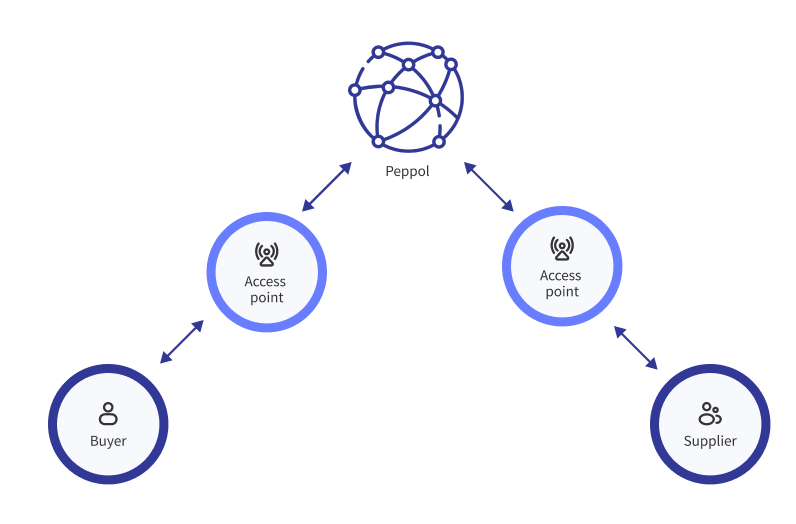
A Peppol ID is the unique electronic address that identifies a company or organization in the Peppol network, used to route e-invoices and other business documents to the right recipient.
A Peppol ID consists of two parts: an initial four-digit code specifying the identifier type and a unique identifier number for a particular company or organization, divided by a colon. For example, the code for a Swedish organization number is “0007”, making Qvalia’s Peppol ID “0007:5567321707”.
Exchanges within Peppol can also use GLN numbers to direct e-invoices and other documents to the right recipient. For companies using GLN numbers, the code “0088” is followed by 13 digits, e.g., “0088:1234567891234”. These codes differ between countries.
With Peppol, there is no need for local network operators with Peppol Access Point status to make specific setups in advance. Most e-invoice operators today are access points, minimizing the risk of transaction issues.
Benefits of Peppol
- Interoperability: Seamless data exchange across different systems and platforms.
- Efficiency: Simplified technical setup and no need for separate operator agreements.
- Cost-effectiveness: Reduced maintenance costs and free transactions with some providers.
- Compliance: Strict controls and validations ensure technical accuracy and compliance with EU invoicing rules.
Message types in Peppol
The profiles below are the European Peppol BIS 3.0 message types. Markets outside Europe use invoice formats based on PINT, the Peppol International invoice model (e.g., JP PINT, PINT A-NZ).
Peppol BIS Billing
Sähköisen laskun muoto Peppolissa. Viestissä on oltava ostajan viite tai ostotilauksen viite, ja laskun riveillä voi olla tuotteita tai palveluja, määrä, nettomäärä, ostajan kirjanpitoviite, ajanjakso, tilauksen viite jne.
Peppol BIS Billing Luottoilmoitus
Hyvityslaskun/hyvityslaskun viesti Peppolissa. Se on Peppol BIS Billing 3 -profiili, jossa käytetään negatiivisia summia asiakirjatasolla.
Peppol BIS Invoice Response
BIS Invoice Response mahdollistaa viestinnän koko laskutusprosessin ajan, esimerkiksi laskun tilasta tiedottamisen.
Peppol BIS Order Only
BIS Order Only on yksinkertaistetun sähköisen tilauksen viestiprosessin profiili. Se voi sisältää esimerkiksi tietoja tuotteista ja palveluista, kirjanpitotietoja, arvoja ja määriä sekä arvonlisäveroa. Lisäksi viesti tukee varastotietoja, kun tilaukset perustuvat luetteloihin.
Peppol BIS Ordering
BIS Ordering on laajennetun sähköisen tilauksen sanomaprosessin profiili. Se sisältää kaikki BIS Order Only :n ominaisuudet, mutta antaa esimerkiksi myyjille mahdollisuuden hyväksyä tai hylätä tilauksia tai tehdä muutoksia.
Peppol BIS Advanced Ordering
BIS Advanced Ordering on edistyksellisin profiili sähköisten tilausviestien lähettämiseen Peppolissa, joka mahdollistaa kaksisuuntaisen viestinnän asiakkaan ja toimittajan välillä.
Peppol BIS Catalogue With/Without Response
BIS Catalogue Ilman vastausta on tuote- ja palveluluetteloviesti. Tavarantoimittajat voivat antaa asiakkaille hinnoittelua ja tuotteisiin liittyviä tietoja, kuten kuvaukset, niihin liittyvät puitteet, pakkaukset ja veroluokat.
Peppol BIS Despatch Advice
BIS Despatch Advice on ilmoitussanoma tapahtuman toteutusprosessissa. Sanoma mahdollistaa kuljetukseen, tilaukseen ja vastaanottoon liittyvät tiedot ja toiminnot. Tuetaan skenaarioita, joissa on erilaisia päätepisteitä ja maksamattomia tavaroita.
Peppol BIS Punch Out
Punch Out on dynaaminen ostoskori B2B-verkkokauppaa varten. Asiakkaat voivat lisätä tuotteita ja palveluja ostoskoriin verkkoluetteloista, tehdä määrityksiä ja lähettää tilauksen toimittajalle.
Peppol BIS Order Agreement
BIS Order Agreement mahdollistaa toimittajien ja asiakkaiden väliset sopimukset. Tavarantoimittajat voivat toimittaa dokumentaatiota ostosta tai kerätä useita ostoja puitesopimukseen.
Peppol BIS Message Level Response
BIS Message Level Response helpottaa viestintää liiketoimen aikana. Osapuolet voivat kuitata prosessin vaiheet ja ilmoittaa poikkeamista tai virheistä. Tärkeimpiä sanomatyyppejä ovat kuljetuskuittaukset, muiden sanomien tietoihin liittyvät vastaukset ja liiketoimintatapahtumiin liittyvät vastaukset.
Data quality and structured data
Business transactions and data management
Improving the quality of your transactional data is key to successfully navigating digital transformation in business messaging. The way you structure your data, the formats you choose, and the type of content you exchange with business partners don’t just affect what you can do now — they play a crucial role in making sure your financial processes are ready for the future.
Success factors for efficient data management
Effective data management in finance relies on two critical factors: data quality and data structure.
Data quality ensures the accuracy, completeness, and reliability of financial data, enabling informed decision-making and regulatory compliance. Meanwhile, a robust data structure organizes and integrates data in a way that allows for efficient automated processes, analysis, and reporting. Together, these factors form the foundation of a resilient financial data management strategy, driving operational efficiency and strategic insight.
Benefits of structured data
- Efficiency and automation: Structured and high-quality data allows for seamless automation of transactional processes, reducing manual intervention and errors.
- Operational consistency: Maintaining high data quality and structure ensures consistent operations across various departments and systems, leading to smoother workflows and reduced operational costs.
- Improved communication: Structured data in standardized formats, such as those supported by Peppol, enhances communication and data exchange between business partners.
- Enhanced analytics: Quality and structured data facilitate advanced data analytics, providing deeper insights and supporting strategic decision-making.
- Regulatory compliance: Structured and high-quality data helps organizations meet regulatory requirements by ensuring accurate and timely reporting.

Tietojen laatu
Data quality is crucial for accurate decision-making, efficient operations, and regulatory compliance. High-quality data is determined by several attributes.
Key aspects of data quality
- Accuracy: Data is correct and free from errors, ensuring financial transactions are recorded correctly, reducing discrepancies.
- Completeness: All necessary data elements are present, preventing operational inefficiencies and misinformed decisions.
- Consistency: Data is uniform across systems, reducing conflicts and misunderstandings.
- Timeliness: Data is up-to-date and available when needed, critical for informed decisions and timely responses.
- Validity: Data conforms to predefined formats and standards, reducing processing errors.
- Reliability: Data is consistently accurate over time, building trust and supporting long-term decision-making.
- Relevance: Data is useful for its intended purpose, ensuring decisions are based on appropriate information.
Data structure
Data structure refers to how data is organized, formatted, and stored in transactional documents; business messages such as e-invoices and e-orders, and systems.
Key aspects of data structure
- Standardization: Consistent formats and standards ensure uniformity and compatibility across systems.
- Normalization: Minimizes redundancy, improving data integrity and reducing storage needs.
- Data models: Blueprints defining data structure, supporting efficient retrieval and management.
- Data formats: Formats like XML, JSON, or CSV ensure compatibility and facilitate data interchange.
- Indexing: Speeds up data retrieval, improving search and processing efficiency.
- Metadata: Provides context, enhancing data usability and discoverability.
Action areas for increased data quality
The caliber of the content in your transactions not only sets the bar for how you can streamline operations and reduce errors but also has the potential to fuel the decision-making process.
Eliminating analog formats, reducing the need for transformations, and increasing the utilization of the Peppol network are three important actions for enhancing data quality. These improve data accuracy and reliability and drive greater efficiency and operational excellence.
1. Eliminating analog formats
The first step towards improving data quality is eliminating analog formats such as paper and PDF invoices, especially supplier invoices. These formats are prone to errors, inconsistencies, and inefficiencies due to manual data entry and interpretation.
By transitioning to fully digital formats, businesses can:
- Reduce errors: Digital data entry minimizes the risk of human error, ensuring greater accuracy.
- Enhance accessibility: Digital formats make data easily searchable and accessible for automated processing.
- Improve efficiency: Eliminating the need for manual handling speeds up transaction processing and reduces labor costs.
2. Reducing the need for transformations
Transformations involve converting data from one format or structure to another, which can introduce errors and inconsistencies.
By reducing the need for such transformations, businesses can:
- Preserve data integrity: Minimizing transformations helps maintain the original accuracy and reliability of data.
- Simplify processes: Streamlining data formats reduces complexity in data management and processing workflows.
- Increase efficiency: Direct data exchange without multiple conversions accelerates transaction times and improves overall process efficiency.
3. Increasing the utilization of the Peppol network
The Peppol network provides a standardized framework for electronic data interchange (EDI), ensuring that data is transmitted in consistent, high-quality formats. By increasing the utilization of Peppol, businesses can:
- Enhance interoperability: Peppol’s standardized formats enable seamless data exchange between different systems and organizations. Peppol is easier to access also for smaller suppliers, contributing to digitization across the supply chain and customer-facing transactions.
- Boost automation: The structured and normalized data within Peppol facilitates automation, reducing manual intervention and associated errors.
- Support compliance: Peppol standards align with regulatory requirements, helping businesses maintain compliance with ease.
Data management cheat sheet
| What | How | Why |
|---|---|---|
| Standardization | Data follows a consistent format and set of standards. | Standardized data ensures uniformity and compatibility across different systems and platforms, facilitating seamless data exchange and integration. |
| Normalization | Data is organized in a way that minimizes redundancy and dependency. | Normalized data reduces storage requirements and improves data integrity by eliminating duplicate data entries. |
| Data models | The schema or blueprint that defines the structure of the data, including entities, relationships, and constraints. | A well-designed data model supports efficient data retrieval and manipulation, enhancing overall data management. |
| Hierarchy and taxonomy | Data is categorized and organized in a hierarchical structure. | Hierarchical organization helps in managing and navigating large datasets, making it easier to locate and analyze specific data points. |
| Data formats | The specific formats in which data is stored, such as XML, JSON, or CSV. | Choosing the right data format ensures compatibility with various software applications and facilitates data interchange. |
| Indexing | Creating indexes to speed up data retrieval operations. | Indexed data structures improve the performance of search queries and data processing tasks, making data access more efficient. |
| Metadata | Data that describes other data, providing context and additional information about the data. | Metadata enhances data usability and discoverability by offering insights into the data’s origin, structure, and usage. |

How to implement Peppol
Aloittaminen Peppolin kanssa
The implementation of Peppol varies depending on the complexity of each specific company. These steps provide common guidance for how to get started.
1. Define your ideal process — start with the end in mind
- Determine how data should enter and exit your company’s systems.
- Identify automation opportunities within your processes; from validation to workflows and analytics.
- Envision the ideal reports and analysis capabilities for decision-makers.
2. Evaluation — get into the specifics of your processes
- Assess which transaction streams need to be digitized, whether on the supplier or customer side, or both.
- Identify relevant internal processes, manual and digital. Assess current state and map needs.
- Decide whether you will receive e-orders, send e-orders, or both.
- Choose the appropriate order message types.
- Involve internal stakeholders.
3. Technical requirements — get into the specifics of your tech
- Specify the data formats compatible with your business systems. Consider adopting Peppol formats to eliminate conversion needs.
- Decide on the integration method, such as API or SFTP.
- Plan for any necessary data conversions.
4. Select a Peppol Access Point — choose a service provider with care
- Verify if the service provider supports the required message types.
- Inquire about error-handling procedures.
- Review integration capabilities, automation options, and data management, including structure, database management, logging, audit trails, etc.
- Evaluate the support and user documentation.
- Assess security measures and business model, including pricing structures.
- Don’t forget to request a product demo, even if you won’t use the graphical user interface. It provides insights into quality and technological sophistication.
5. Roadmap implementation — plan the integration
- Plan the implementation of transaction flows, including steps for both inbound and outbound transactions and communication with business partners.
- Address master data management, including customer and supplier registries and potential data migration.
6. Onboarding — finalize integration and onboard users
- Register for Peppol IDs.
- Integrate and implement the system.
- Test streams.
- Train and onboard internal users.
- Assign roles and permissions.
Usein kysytyt kysymykset
Do I need a Peppol ID to send e-invoices?
No. A Peppol ID is only required to receive e-invoices and other e-documents within the network. To send, you only need an agreement with a certified Peppol service provider (access point).
What does Peppol cost?
Fees vary between service providers. Typical models include fixed subscriptions and per-transaction fees. There is no fee from OpenPeppol itself for participating in the network.
Is Peppol mandatory?
It depends on the country. Many European public-sector bodies require e-invoices via Peppol, and a growing number of national B2B e-invoicing mandates — such as Belgium’s from 2026 — are built on or interoperable with Peppol. The EU’s ViDA reform mandates structured e-invoicing for intra-EU B2B transactions from 2030.
What is the difference between Peppol and EDI?
EDI is the collective term for exchanging business documents electronically, traditionally through costly point-to-point connections or VAN operators. Peppol is an open network and a set of standardized formats: one connection to a certified access point reaches every participant, with no bilateral setups.
This guide is based the lessons from our Peppol Academy webinary series.