- Beyond e-invoicing
- Qu'est-ce que la passation de marchés en ligne ?
- Les tendances qui façonnent le marché de l'approvisionnement électronique
- Why structured data matters in integrated digital trade
- How the Peppol network changes business messaging
- Business message types in Peppol
- What are e-orders?
- How the Peppol e-order process works
- Qu'est-ce que punchout?
- How to get started with e-orders: a buyer’s guide
- Integrated digital trade with Qvalia
- Questions fréquemment posées

How integrated digital trade — e-orders, punchout, and structured business messages on the Peppol network — transforms procurement and sales. The trends, the technology, and how to get started.
Last updated June 2026.
To connect with suppliers, customers, and partners seamlessly and digitally — what we call integrated digital trade (IDT)— is rapidly moving from advantage to necessity. Let’s explore how to transform sales and purchase processes, e-procurement, and B2B e-commerce with technology.
Electronic invoicing has become a natural business medium. This development has been fast-tracked by clear user value in process efficiency, lower costs, and security. Another strong driver is improved accessibility, driven by the expanding Peppol network. The role of national legislative mandates can’t be underestimated either.
However, the most transformative outcome from the growing use of e-invoices might be digital maturity. Companies are changing their mindset about how new technology can manage sales and purchase transactions — a development that has only just begun.
Beyond e-invoicing
The adoption of electronic business messages, and the digital exchange of transactional information, have prompted a shift in perspective among finance teams, procurement, and IT.
Today, companies increasingly assess their needs and capabilities from a digital-first point of view, independent of centuries-old accounting processes. They have realized that business value, at its core, is not held within the medium per se, but in the data it carries.
In this guide, we provide an overview of the opportunities of integrated digital trade — connecting businesses digitally, end to end. What are the next steps beyond e-invoice management to advance business processes? How can sales and purchase transactions become more streamlined, more automated, and provide deeper insights? How do you effectively use e-orders, punchout, and response messages? Read on to learn the trends driving the development, its emerging technologies, and how to get started.
Qu'est-ce que la passation de marchés en ligne ?
E-procurement is the digital management of purchasing — sending and receiving orders, catalogs, and responses as structured electronic messages rather than paper or PDF. On the Peppol network, buyers and sellers can automate the full order-to-invoice process with lossless, machine-readable data, reducing manual work and errors.
Les tendances qui façonnent le marché de l'approvisionnement électronique
What is shaping the development in business messaging, making companies take the next step from e-invoicing, deeper into the digitization of sales and purchase processes? Digital transformation is a massive trend, so let’s break it down into the most relevant parts.
Multiple trends and tendencies are at play driving companies to expand the use of digital business messages. Here are the prolific trends:
- Policy shifts
- Emerging standardization
- Simplified and smarter connectivity
- Evolving buying behavior
1. Policy shifts: governments mandate e-invoices — and more to come
A significant factor in recent years’ adoption of electronic business messages has been the increasing number of national e-invoicing mandates. A notable example is the EU Directive 2014/55/EU, but there are numerous national mandates and roadmaps worldwide.
E-invoicing in B2G transactions marked the first step adopted in many European countries and notable first-movers in e.g. Asia and America. The future holds further policy shifts. E-orders are already here — Finland was among the first in Europe, going live with Peppol Advanced Ordering on April 1, 2024, and extending it across public procurement through 2026. The EU’s ViDA (VAT in the Digital Age) reform package was adopted on March 11, 2025, introducing digital reporting and e-invoicing requirements that roll out progressively, with cross-border B2B digital reporting from July 2030. CTC (Continuous Transaction Controls) requirements continue to spread internationally.
These initiatives are clear indications of a broader commitment to standardizing financial and trade operations with greater transparency.
National mandates for business messaging
The landscape of national e-invoicing and e-reporting mandates is changing fast. See the current, country-by-country status in our Peppol global reach guide.
2. Emerging standardization: a common international language for business messaging
Interoperability, formats, testing, distribution, complex pricing — the list of hurdles has been long for companies implementing and using business messages. For the first time, these challenges have been significantly reduced, if not eliminated.
Peppol, an open business network initiated by an EU project and now managed by the non-profit OpenPeppol, is growing into a global infrastructure. The network has significant momentum compared to legacy VAN solutions, with participants in 100+ connected countries and multiple national Peppol mandates for e.g. B2G invoicing working in its favour. The key benefits are the combination of standardized data formats for a complete set of messages and the distribution infrastructure for communication, including an open directory for participants which simplifies connectivity between business partners, for companies of all sizes.
Peppol Directory lookup
Find companies registered in the Peppol network in the open Peppol Directory.
3. Simplified and smarter connectivity: new services democratize business messaging
Innovative services are democratizing access to even the most advanced business messaging capabilities — a levelling of the playing field for small and medium-sized companies.
With the accessibility of the business network Peppol, cloud services, and simplified connectivity using APIs and ready-made connector apps, new services offer cost-effective solutions that were once reserved for larger enterprises with equally large resources. Legacy service providers in business messaging are pressured to adapt and compete. The emergence of accessible, budget-friendly options is empowering SMEs to leverage the benefits of business messaging, enhancing their operational efficiency and competitiveness in the market.
4. Evolving buying behavior: the consumerization of B2B e-commerce
Consumer buying experiences in the digital realm have set new expectations for B2B e-commerce, which is a significantly larger market than B2C. As individuals enjoy the convenience of online shopping, businesses are increasingly demanding similar ease and efficiency in their procurement processes. Corporate credit cards, with costly merchant fees and paperwork, aren’t optimal for B2B buyers.
This evolving B2B buying behavior underscores the importance of smart business messaging, secure authentication, user-friendly interfaces, streamlined workflows, and personalized experiences. The trend is continuing, and companies embracing technologies for B2B e-commerce — for example, punchout and the smart use of e-ordering and e-procurement — are better positioned to attract and retain customers and build long-term business partnerships.
B2B e-commerce global market size
≈ EUR 6,900 billion (2026)*
*Straits Research, B2B Ecommerce Market, 2026 (USD 8,002.7 billion, converted at EUR 1 ≈ USD 1.16).
Why structured data matters in integrated digital trade
Enhancing the quality of financial data is an integral aspect of digital processes and getting the benefits of speed, automation, and analytics.
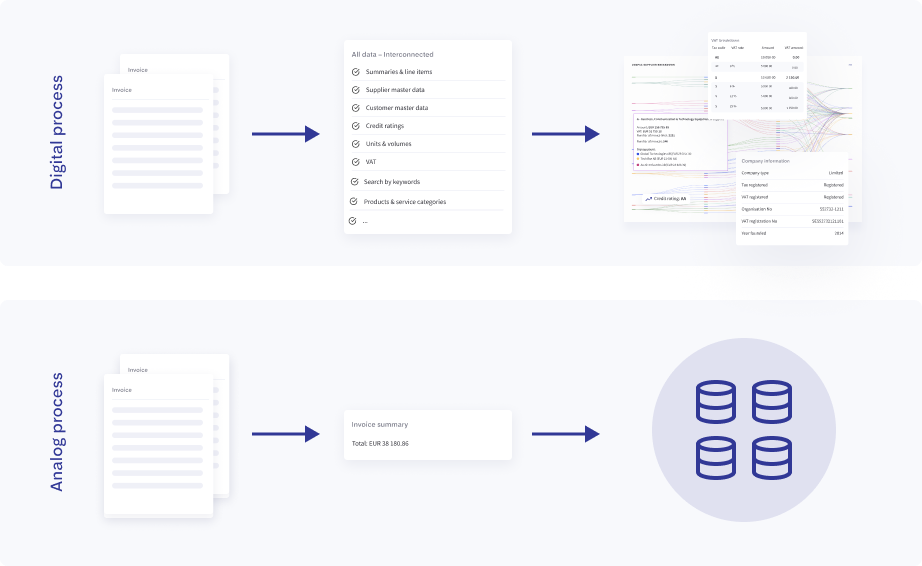
The quality depends on the content and the degree of structure. The content in transaction processes is all the information related to a purchase or sales event — for example, line items (purchased products and services), units, quantities, and VAT. The degree of structure is how the data is stored and made searchable and accessible for machine-reading.
Orders, invoices, and other business messages using analog formats — PDF, print — might very well contain the information you need, but the medium is not directly interpretable by your software solutions. The sender might have it properly stored in its ERP, but not the receiver, who needs to interpret and convert the format — for example, manually or using OCR solutions, with significant data loss, workarounds, and wasted time as a consequence.
Procurement systems have mainly been developed for analog processes, requiring manual work and input. Most do not support dynamic processes, such as punchout and Peppol, and the structured transmission of data.
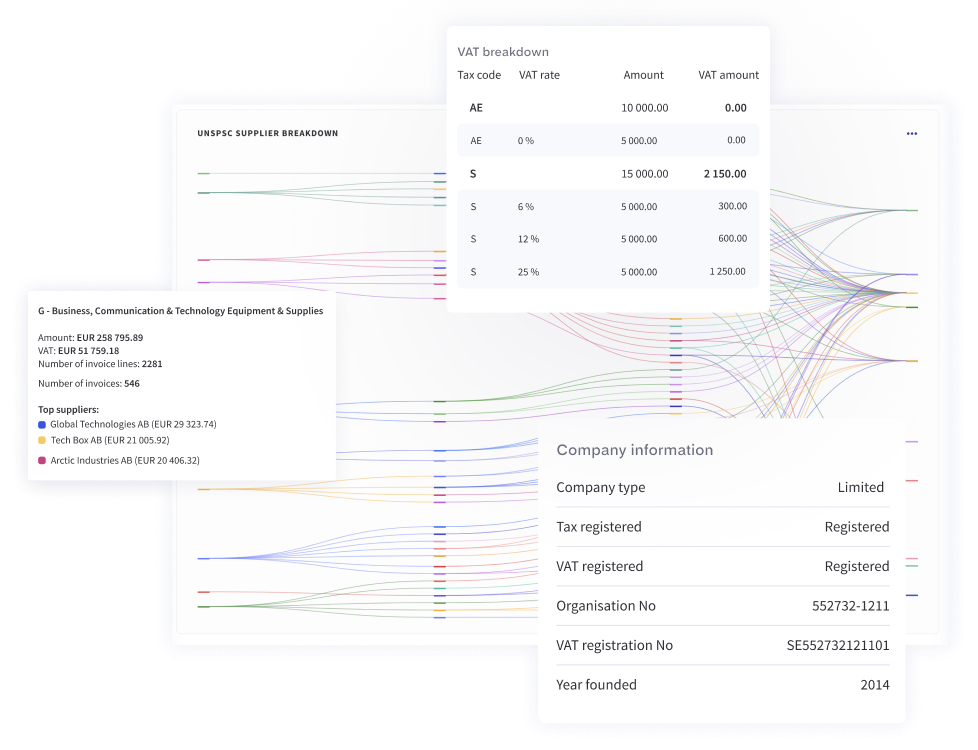
When adopting fully digital business messages in a standardized format, companies use a common data language with their business partners. The exchange is immediate, and all content of each transaction is lossless and machine-readable by the ERP, accounting system, or supporting business systems. This type of data is ideal for process automation, since software generally has no problem parsing, searching, and editing the information.
How the Peppol network changes business messaging
Implementing electronic business messages into daily processes has previously been a bit of a challenge. Not anymore.
A deeper integration into various business processes has been — and in many cases still is — technically complex. It affects accounts payable and receivable, sales and purchases, workflows, and accounting, with integrations into various business systems. Furthermore, it has required financial resources: investments for implementation and operating costs. Thanks to the Peppol network, this is about to change.
In part, challenges have been due to accessibility. Besides one-to-one EDI connections, hardcoded between companies, users have relied on the Value-Added Network (VAN) and service providers to exchange information with partners, customers, and suppliers. Heavily relying on FTP file transfer, the availability of swift API integrations has been rare.
The Peppol network differs significantly in key aspects. Peppol is an open business network, initiated by an EU project and managed as a non-profit. One of its standout advantages lies in merging standardized data formats with a robust network and distribution infrastructure for exchange. It includes an open directory for participants, which simplifies connectivity between business partners. This has contributed to making Peppol accessible to companies of all sizes, easier to operate and integrate, and highly cost-efficient.
Peppol vs. VAN
| Peppol | VAN |
|---|---|
| Open network | Multiple format standards |
| Standardized | National, regional requirements and limitations |
| International | Complex interoperability |
| Cost-efficient | Costly |
Business message types in Peppol
Peppol covers a complete set of structured business messages across the transaction lifecycle:
- Peppol BIS Billing — e-invoice message.
- Peppol BIS Billing Credit Note — credit invoice, also known as a credit note.
- Peppol BIS Invoice Response — invoice response message from receiver to sender.
- Peppol BIS Order Only — simplified e-order message.
- Peppol BIS Ordering — extended e-order message.
- Peppol BIS Catalogue Without Response — product and service catalog message.
- Peppol BIS Catalogue With Response — product and service catalog message with response properties.
- Peppol BIS Despatch Advice — notification message in the transaction fulfillment process.
- Peppol BIS Punch Out — dynamic shopping cart for e-commerce transactions.
- Peppol BIS Order Agreement — agreement or purchase message.
- Peppol BIS Message Level Response — communication during a transaction process.
Peppol outside the EU: PINT
The BIS specifications above are the European profiles. For non-European markets, Peppol uses PINT (the Peppol International invoice model), a common base aligned to local requirements — for example JP PINT (Japan), PINT A-NZ (Australia and New Zealand), and MY PINT (Malaysia). This lets Peppol scale globally while respecting national tax and format rules.
What are e-orders?
An e-order is a structured electronic purchase order exchanged over a business network such as Peppol. Delivered instantly in a standardized format, it can be processed automatically in an order management system or ERP — and, with response messages, the seller can accept, adjust, or reject it, sending stock and delivery details back the same way.
For procurement processes, utilizing a wider range of standardized business messages is transformative. By implementing e-ordering and dynamic response messages, companies can deepen the automation of processes, their control and responsiveness, and the automation of workflows, accounting, and sourcing. In other words, it’s the next step in financial digital transformation after e-invoicing.
Six arguments for e-ordering
1. Amélioration de l'automatisation des processus
E-orders take the concept of automation to the next level by encompassing not just the invoicing process but also the entire sales and purchasing workflow. From order initiation to payment processing, each step can be seamlessly integrated and automated to a higher degree, reducing manual work and error risks.
2. Authentification et sécurité
3. Réduction des erreurs
Manual data entry is prone to errors, which can be costly and time-consuming to rectify. E-orders significantly reduce the likelihood of errors, as data can be transferred automatically between systems, created from e-catalogs, and from e-commerce websites via punchout, without the need for manual input.
4. Faciliter le commerce électronique interentreprises
E-orders are an enabler for efficient B2B e-commerce. Companies can place and receive e-orders online via Peppol, opening up improved customer service, control, and growth. Advancing this concept further with punchout — a combination of process, order message, and shopping cart — B2B e-commerce can be even more seamless than the consumer shopping experience.
5. Speed and efficiency
The speed at which e-orders can be processed is a significant advantage. Unlike traditional emails or paper-based orders, electronic orders are transmitted instantaneously and losslessly.
6. Des analyses plus approfondies
Electronic transactions provide a goldmine of data that can be harnessed for detailed analysis. E-orders are closer to the purchasing event than invoices. By capturing transactional information digitally, businesses can gain insights into purchasing patterns, supplier performance, and cost optimization opportunities.
How the Peppol e-order process works
The Peppol network provides a structured and standardized order process for buyers and sellers, using the message types BIS Ordering and Order Only, with secure and instant information exchange. Peppol’s setup defines field requirements, including mandatory elements, enhancing consistency and usability for all parties in a transaction.
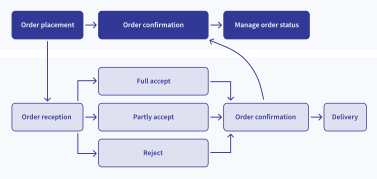
E-ordering step-by-step
- The buyer initiates the e-order through a Peppol service provider or via a purchasing system with Peppol capabilities. The product information can be derived from, for example, e-catalogs. The buyer needs the seller’s Peppol ID.
- The order is sent as a structured message via the network to the seller. The purchase order is managed within the service provider’s system or in an order management system.
- The order can be accepted entirely, partly with adjustments, or rejected by the supplier.
- The seller responds with a response message, including for example stock and delivery information. Peppol also supports order processes without response messages.
- The buyer can update the order status in their system, automatically or manually, and the seller proceeds with the delivery according to the agreement.
Qu'est-ce que punchout?
Punchout is a combination of a business message and process that connects a buyer’s procurement system directly to a seller’s online catalog. The buyer “punches out” to the supplier’s store, builds a cart with buyer-specific pricing, and returns it to their own system as an order — combining the familiar e-commerce experience with structured, automated ordering.
Peppol’s punchout message, named Peppol BIS Punch Out, offers an advanced and dynamic ordering process, surpassing Peppol BIS Ordering in flexibility and ease of use for both buyers and sellers. This process combines order and catalog functionalities, providing innovative possibilities and adaptable design options, making it ideal for e-commerce scenarios for B2B transactions.
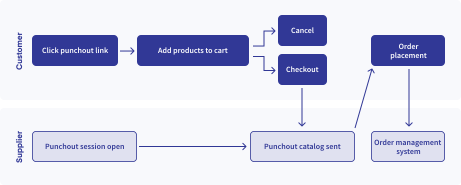
Punchout step-by-step
- The buyer initiates the process by clicking on a punchout link, available on the seller’s website or e-commerce platform, intranet, or via email.
- This link establishes a punchout session, fetching relevant catalog information, such as buyer-specific pricing and product details.
- The buyer adds desired products or services to their shopping cart — a familiar e-commerce shopping experience.
- At checkout, the buyer decides whether to proceed with the order or cancel it, mirroring standard e-commerce procedures.
- The completed punchout order is sent back to the seller, adhering to Peppol’s e-catalog format, containing ordered items, availability, delivery times, and more.
- This data is relayed to the customer’s system (e.g., a purchasing system), where it’s transformed into an order. The order is then sent back to the supplier, who processes it using their order management system.
Un guide pour E-commandes
Read more about the e-order process in Peppol in our guide to e-orders.
How to get started with e-orders: a buyer’s guide
The implementation of e-orders varies depending on the complexity of each specific company. However, these steps provide common ground for each organization, large or small, whether e-orders are to be used in procurement, in sales, or both.
1. Définir le processus idéal
Start with the end in mind.
- Determine how data should enter and exit your company’s systems.
- Identify automation opportunities within your processes; from validation to workflows and analytics.
- Envision the ideal reports and analysis capabilities for decision-makers.
2. L'évaluation
Get into the specifics of your processes.
- Assess which transaction streams need to be digitized, whether on the supplier or customer side, or both.
- Identify relevant internal processes, manual and digital. Assess the current state and map needs.
- Decide whether you will receive e-orders, send e-orders, or both.
- Choose the appropriate order message types, including punchout and ideal responses.
- Involve internal stakeholders.
3. Technical requirements
Get into the specifics of your tech.
- Specify the data formats compatible with your business systems. Consider adopting Peppol formats to eliminate conversion needs.
- Decide on the integration method, such as API or SFTP.
- Plan for any necessary data conversions.
4. Select a Peppol Access Point
Choose a service provider with care.
- Verify if the service provider supports the required message types.
- Inquire about error-handling procedures.
- Review integration capabilities, automation options, and data management, including structure, database management, logging, audit trails, etc.
- Evaluate the support and user documentation.
- Assess security measures and business model, including pricing structures.
- Don’t forget to request a product demo, even if you won’t use the graphical user interface. It provides insights into quality and technological sophistication.
5. Roadmap implementation
Plan the integration.
- Plan the implementation of transaction flows, including steps for both inbound and outbound transactions and communication with business partners.
- Address master data management, including customer and supplier registries and potential data migration.
6. Embarquement
Finalize integration and onboard users.
- Register for Peppol IDs.
- Integrate and implement the system.
- Conduct testing if needed.
- Train and onboard internal users. Assign roles and permissions as needed.
Integrated digital trade with Qvalia
Connect your business and get dynamic business messaging, e-invoicing and e-order management on the Peppol network. Gain full control, automate processes, and integrate via API. Combine invoices and orders with punchout for seamless B2B e-commerce, and turn orders into invoices with a few clicks.
Questions fréquemment posées
Qu'est-ce que la passation de marchés en ligne ?
E-procurement is the digital management of purchasing — exchanging orders, catalogs, and responses as structured electronic messages rather than paper or PDF. On the Peppol network it lets buyers and sellers automate the full order-to-invoice process with lossless, machine-readable data.
What is the difference between an e-order and an e-invoice?
An e-order is the structured purchase order that initiates a transaction; an e-invoice is the structured bill that completes it. E-orders sit closer to the purchasing event, so they enable earlier automation and richer analytics. Both are exchanged over Peppol as standardized business messages.
What is punchout in Peppol?
Punchout (Peppol BIS Punch Out) connects a buyer’s procurement system directly to a seller’s online catalog. The buyer browses the supplier’s store with buyer-specific pricing, builds a cart, and returns it to their own system as a structured order — combining the e-commerce experience with automated, lossless ordering.
What are the benefits of e-orders?
E-orders deepen process automation across the whole purchasing workflow, improve authentication and security, reduce manual errors, enable efficient B2B e-commerce, speed up processing with instant lossless transmission, and provide richer analytics on purchasing patterns, supplier performance, and cost optimization.
How do I get started with e-orders?
Define your ideal process, evaluate which transaction streams to digitize, specify technical requirements, select a Peppol Access Point that supports the message types you need, plan the implementation roadmap, and onboard your team — starting with registering for Peppol IDs.
Is e-invoicing mandatory in the EU?
Increasingly. B2G e-invoicing is already required across the EU under Directive 2014/55/EU, and many countries have or are introducing B2B mandates. The EU’s ViDA (VAT in the Digital Age) package, adopted in March 2025, introduces digital reporting and e-invoicing requirements that phase in progressively through 2035, with cross-border B2B digital reporting from 2030. Check our country guide for current status.