- What is a Peppol e-order?
- Why e-orders, and why now
- Qu'est-ce que Peppol ?
- VAN vs. Peppol
- Peppol ID for e-orders
- Peppol message types
- How e-ordering works in Peppol
- E-orders, policy, and the Nordics
- How to get started with e-orders
- L'avenir de la E-commandes
- E-order management with Qvalia
- Questions fréquemment posées
A complete guide to electronic ordering on the Peppol network — what e-orders are, the message types and order profiles, the order and punchout process, the policy landscape, and how to get started.
Last updated June 2026.
What is a Peppol e-order?
A Peppol e-order is a structured electronic purchase order exchanged through the Peppol network in a standardized format (Peppol BIS). It is delivered instantly to the seller’s Peppol ID and can be processed automatically in an order management system, with responses such as acceptance, change, or rejection sent back the same way.
In this guide we cover the value of e-orders, the forces driving their adoption, the advantages of the Peppol network, how it differs from the traditional VAN network, the message types and order profiles, how the order and punchout processes work, the policy landscape, and how to get started.
Why e-orders, and why now
Electronic business messages are transaction-related documents companies exchange digitally when trading goods and services.
Electronic invoices are the most common, but there are business messages covering all steps in a transaction process, including ordering, delivery notes, responses, and credit notes. Business messages offer numerous advantages over analog formats such as PDFs and prints, for both buyers and sellers: a business message is transferred instantly and securely with a significantly reduced risk of errors and no data loss, enabling more effective automation and analytics and cutting the overhead lifecycle cost of managing transactions.
E-invoices have been in use for years. In Finland, around 98% of business-to-government invoices are already electronic — among the world’s highest adoption rates — and nearly 90% of business-to-business invoices are sent electronically.
Key business messaging trends
- Simplified usage as the European business network Peppol consolidates national message formats and networks into one international standard.
- Increased use of additional electronic messages digitizes and standardizes a greater part of the transaction process, for example e-orders.
- Government mandates and legislation accelerate the adoption among businesses as governments strive for efficiency and transparency.
As new business message types become digital and structured, the logic of the transaction process — purchasing, procurement, e-commerce — also changes. Here are four forces driving development.
1. New legal requirements
New legal requirements originating from EU Directive 2014/55/EU drive a joint harmonization and consolidation of fragmented national and company-specific standards for electronic business messages. The directive requires public bodies to be able to receive e-invoices to the European standard EN 16931; it does not itself mandate Peppol — that is a national delivery choice.
2. New digital infrastructure
3. New purchasing patterns
Legal requirements and new infrastructure affect purchasing patterns. E-commerce is an ongoing megatrend in both B2C and B2B, raising expectations for product information and accessibility. Until now, digitization has happened mainly at the invoice level; in future, more of the purchasing process — orders, e-catalogs, delivery notifications — will be affected.
4. New platforms, systems, and tools
As the market playbook is standardized and demand grows, new tools and systems emerge. As transactional information becomes more structured, new capabilities for insight, analysis, and automation appear — leveling the playing field so even the smallest companies can access solutions once reserved for large organizations.

Qu'est-ce que Peppol ?
Peppol is an open international network for exchanging structured electronic business messages — e-invoices, e-orders, catalogs, and more — based on the 4-corner model. It is a modern way of managing business messages and one of the fastest-growing networks for electronic trade, replacing a fragmented landscape of national formats and closed networks with a single standard and a single distribution infrastructure, accessible to organizations of all sizes.
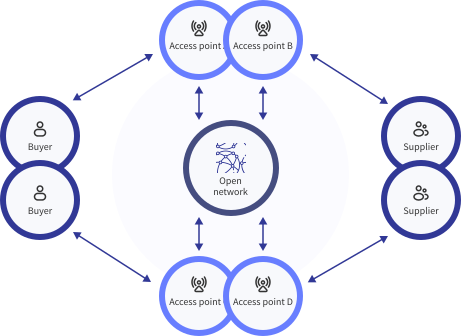
It differs from how business messages have previously been exchanged, using a closed network of service providers (VAN). Peppol is an open international business network, initiated by an EU project and now managed by the non-profit OpenPeppol. The only requirements to send a message are access to the network via an access point and the recipient’s Peppol ID. An access point can always deliver a message regardless of type — both e-invoices and e-orders, for example — with no approvals or technical connections required between operators.
Previously, service providers of business messaging had to test and set up connections between each business partner.
A prominent benefit is its standardized data formats, combined with an international network and distribution infrastructure for seamless exchange, replacing a multitude of national data formats and traditional EDI messages. Peppol also includes an open directory for participants, which simplifies connectivity between business partners. As of 2026, 45+ countries and territories are members of OpenPeppol, including all EU countries, with non-European members such as Australia, New Zealand, Singapore, and Japan. In Sweden, for example, B2G e-invoicing has been mandatory since April 2019, overseen by the digitization agency DIGG, the Swedish Peppol Authority. See current status by country in our Peppol global reach guide.
One reason Peppol gained such a strong position so quickly is its openness: the network is like a telephone directory where no one owns the record. Registration is free, and you can switch access points to change service provider. E-invoices and e-orders can be created directly in an access point’s web interface, which suits small businesses, or integrated via API for larger organizations (an older model uses SFTP servers).
National formats in the Nordics
- Finvoice – Finland
- Svefaktura – Sweden (discontinued)
- OIOUBL – Denmark (migrating to NemHandel BIS 4, based on Peppol BIS 4, across 2028–2029)
- EHF – Norway (EHF Billing 3.0 is aligned with Peppol BIS Billing 3.0)
National formats across the Nordics are converging on Peppol. Denmark has confirmed it will replace OIOUBL with NemHandel BIS 4 — built on Peppol BIS 4 — with migration running across 2028 and 2029. Norway’s EHF Billing 3.0 is already aligned with Peppol BIS Billing 3.0, and Norway has introduced a B2B e-invoicing mandate starting January 1, 2027 (e-invoice issuance). The direction of travel is clear: a single, shared European standard in place of fragmented national formats.
VAN vs. Peppol
There is a significant difference between the Peppol network and traditional business network solutions. Beyond direct EDI connections, e-invoices and other documents have primarily been exchanged via VAN operators — closed networks where private operators create connections among themselves. Peppol shifts the logic: no prior connection or setup is required between specific operators. Any access point can distribute messages to any organization; the only requirement is a Peppol ID, the unique address of each connected end user.
VAN vs. Peppol compared
| VAN | Peppol |
|---|---|
| Connexion entre les parties requise | Aucune connexion entre les parties n'est nécessaire |
| Tests requis | Réduction de la nécessité d'effectuer des tests |
| Conversion nécessaire | Format standardisé |
| Risk of international limitations | Recipient’s country must be connected |
| Slow process, high running costs | Only a Peppol ID needed to receive, low running costs |
The simplicity significantly reduces the need for testing compared with the VAN network, where testing is a key part of setup and drives cost and manual work. Because the VAN network connects actors across regions, it results in a variety of file formats and XML-based message types, requiring data conversion in each ERP — at a cost and effort, with a constant risk of losing valuable data. One disadvantage of Peppol is that the recipient’s country must be connected by a so-called Peppol Authority — often a government body (in Sweden, DIGG). Even so, Peppol is a cheaper, faster, and more flexible solution for almost all organizations, which has driven its strong growth.
Peppol ID for e-orders
Each recipient of messages, for example e-orders or e-invoices, has a unique Peppol ID. Sellers need a Peppol ID to receive e-orders; buyers need a Peppol ID to receive e-invoices on ordered goods or services. The recipient’s Peppol service provider (the Peppol Access Point) registers the organization on the network by creating one or more Peppol IDs, ensuring that messages are delivered to the recipient.
The Peppol ID registration specifies which types of messages can be received, and the information is openly accessible in the directory for all participants. Together, the distribution network, the use of Peppol IDs, and common message format standards make business messaging accessible to companies of all sizes, significantly easier to use and integrate, and highly cost-efficient.
Peppol message types
Peppol covers a complete set of structured business messages across the transaction lifecycle — e-invoices, credit notes, orders, catalogs, despatch advice, and response messages:
The message types in Peppol
- Peppol BIS Billing
- Peppol BIS Billing Note de crédit
- Peppol BIS Invoice Response
- Peppol BIS Order Only
- Peppol BIS Ordering
- Peppol BIS Advanced Ordering
- Peppol BIS Catalogue with Response
- Peppol BIS Catalogue without Response
- Peppol BIS Despatch Advice
- Peppol BIS Punch Out
- Peppol BIS Order Agreement
- Peppol BIS Message Level Response
How e-ordering works in Peppol
Peppol e-orders make sales and procurement processes more efficient and secure, with increased automation and improved communication between buyer and seller throughout the transaction. Peppol uses a single structured order format with three profiles that enable varying degrees of communication, and adds punchout for dynamic B2B e-commerce.
The three ordering profiles
The profiles enable a varying degree of communication throughout the order process.
Peppol BIS Order Only
In the simplified ordering process using Peppol BIS Order Only, the customer sends an e-order without the capabilities of further communication. The supplier cannot respond to the e-order with acceptance, rejection, or change.
Peppol BIS Ordering
Compared to BIS Order Only, Peppol BIS Ordering enables additional communication capabilities between the customer and the supplier. The profile enables customers to send e-orders, and suppliers can reply with acceptance, order change, or rejection.
If the customer doesn’t accept the supplier’s changes to the original e-order, the customer can only respond manually, for example, by sending a new e-order.
Peppol BIS Advanced Ordering
BIS Advanced Ordering enables a complete process, allowing more dynamic and seamless communication capabilities in Peppol, compared to BIS Order Only and BIS Ordering.
The profile enables two-way communication and real-time updating, allowing customers and suppliers to change or cancel the e-order within the same ordering process without additional steps.
The order process, step by step
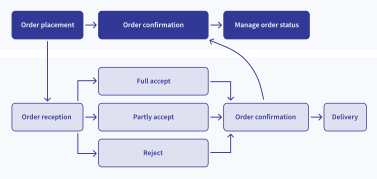
In Peppol, the order process and information exchange are structured and follow a unified standard, delivering instant, lossless, and secure distribution. The transactional information is machine-readable, and Peppol’s rules specify what each field must contain, which are mandatory, and other requirements. The seller can respond with detailed information such as stock and delivery time, and incoming e-orders can be accepted in full, partially, or rejected.
The difference from manual handling is obvious in terms of efficiency and security.
- The buyer initiates the e-order, through a Peppol service provider or via a purchasing system with Peppol capabilities, by sending the message using the buyer’s Peppol ID.
- The incoming e-order is managed using an order management system (OMS).
- The e-order can be accepted entirely, partly with adjustments, or rejected by the supplier.
- The seller communicates back using a response message. The response can include, for example, stock and delivery information.
- The buyer can update the order status in its system, automatically or manually, and the seller proceeds with the delivery according to the agreement.
When a supplier partly accepts, the response can be line-based — highlighting changes such as quantity or specifying substitute products — and Peppol also supports order processes that do not require an order confirmation. The Peppol BIS Ordering message carries information about the order and the status of requested products or services, but not about the process itself. That is what Peppol BIS Punch Out adds, with a whole layer of on-demand flexibility.
Punchout: dynamic ordering for B2B e-commerce
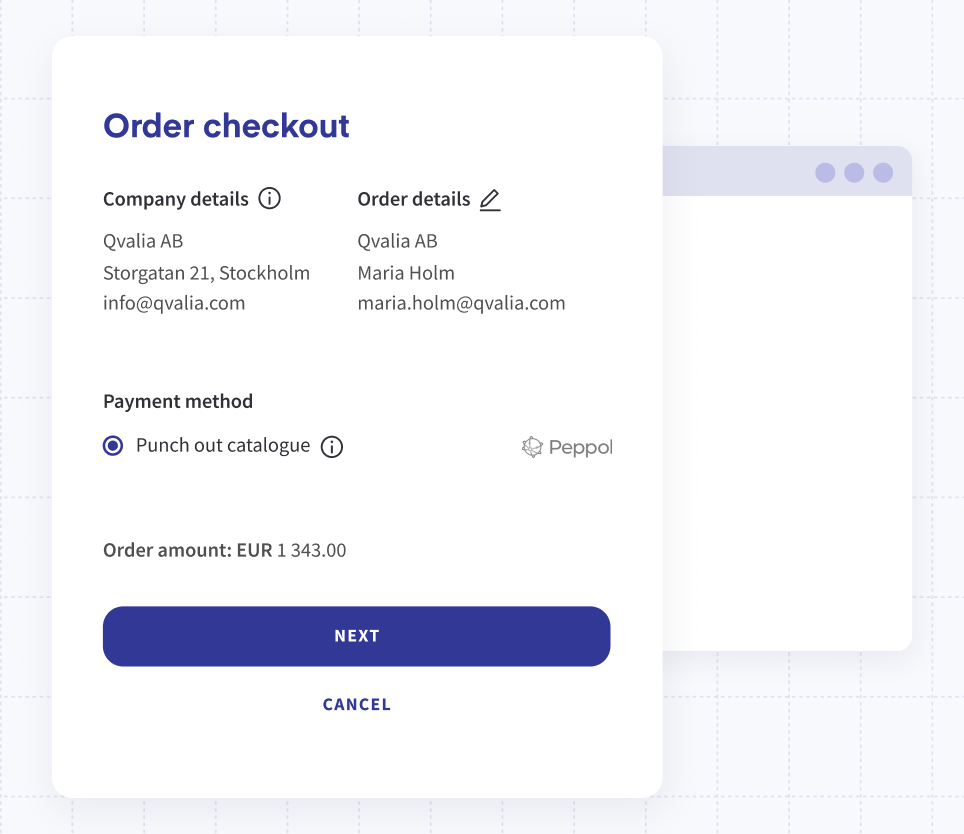
Punchout is a combination of a business message and process that connects a buyer’s procurement system directly to a seller’s online catalog. The buyer “punches out” to the supplier’s store, builds a cart with buyer-specific pricing, and returns it to their own system as a structured order — combining the familiar e-commerce experience with automated, lossless ordering.
The business message Peppol BIS Punch Out enables a more advanced and dynamic ordering process than Peppol BIS Ordering, with more flexibility for both buyers and sellers — especially in traditional e-commerce. It combines order and catalog into a single process, ideal for B2B e-commerce scenarios.
- The process typically starts with the customer clicking a punchout link — on the supplier’s website, an e-commerce platform, an intranet, or via email.
- The link creates a punchout session that pulls in relevant catalog information— such as current price lists for a specific customer, campaigns, or general prices (pricing may be session-specific).
- The customer adds requested products or services to a shopping cart — an experience identical to common e-commerce sites.
- At checkout, the customer chooses to cancel or place the order, just as on any e-commerce solution.
- After checkout, the composed punchout catalog is sent back to the supplier, following Peppol’s e-catalog format but containing only the cart items, with availability, delivery times, and other details.
- This information is sent to the customer’s system (e.g., a purchasing system), which converts the punchout catalog into an order and sends it back to the supplier, who processes it in their order management system.
Avantages de la punchout
- Business customers can make secure purchases in an e-commerce solution and avoid card processing.
- All relevant purchase information is documented, structured, and digitally available.
- Prices and other purchase information are updated and correct.
- The risk of deviations between order and invoice is eliminated.
- Suppliers avoid costly card-processing fees.
- The authentication Peppol provides, combined with internal workflows, minimizes fraud risk and can restrict purchases beyond spend limits.
E-orders, policy, and the Nordics
Peppol is supported by authorities at all levels in Europe. B2G use cases have been legislated through directives, and private-sector companies must use the network to send invoices to municipalities, regions, and government authorities.
The Nordic Council of Ministers established the Nordic Smart Government & Business (NSG&B) initiative to promote technology development, with Peppol as the infrastructure and the goal of harmonizing regulations across Denmark, Finland, Iceland, Norway, and Sweden. The programme’s ambition was for the region to become the world’s most integrated by 2027. NSG&B entered its active phase in 2021 and completed a pilot on harmonizing e-orders and e-invoices in 2022. The programme concluded at the end of 2024, and Nordic cooperation has continued in selected areas since.
A key milestone came in 2024: as the first market in Europe, Finland began moving public procurement to e-orders. From 1 April 2024, the Finnish State Treasury required public-sector orders to be sent electronically through Peppol, meaning suppliers had to be able to receive these orders and send order responses via the network. The rollout has since extended across applicable public procurement through 2026, and more countries are expected to follow Finland’s example.
Compliance and reporting: CTC and ViDA
How to get started with e-orders
It is already possible to digitize your order processing today while future-proofing access to all Peppol message types and content, ensuring compliance for both customers and authorities. In practice, getting started means deciding whether you will send e-orders, receive them, or both; choosing the right message types and profiles (including punchout); registering for a Peppol ID; and selecting an access point that supports the messages and integration you need.
What you need to get started
- Peppol ID registration required to receive e-orders.
- An order management system, ERP, or similar software with capabilities to review incoming e-orders. Get complete e-order management capabilities by signing up to Qvalia.
- Order response features to enable acknowledgment, rejection, comments, and more.
L'avenir de la E-commandes
With around EUR 2,000 billion in annual purchasing volume, the European public sector remains a significant force for change by setting requirements on its suppliers. Today, invoices to the public sector must be electronic, and new policies — such as e-orders and e-catalogs — are underway. These changes can happen relatively quickly, as Finland’s 2024 e-order requirement showed. Specific organizations also make demands: in Sweden, the Employment Agency required its suppliers in 2021 to be able to receive e-orders with a few months’ notice. The digitization of order management — and a shifting emphasis from invoice to order — will reshape how companies handle transactions. Ten ways we believe the B2B transaction landscape will change:
- The importance of the invoice will decrease. The order precedes the invoice and contains all relevant invoice information, but sits closer to the transactional agreement and sets new demands, e.g., on accessibility.
- Traditional invoice-management systems will be less central. As the order grows in significance, more validation checkpoints move from the invoice to the order level.
- Order financing grows. Services like traditional factoring lose ground to models based on order financing.
- New requirements on the data you provide. Information must be structured and standardized; customers may require product/service classification, and critical data, such as pricing, must remain synchronized in your ERP.
- User behavior changes. B2B buyers order less by phone or email; punchout makes purchasing more flexible and location-independent.
- Traditional e-commerce systems must adapt to changing platforms, user requirements, and new technologies such as punchout.
- Product, price, and inventory data must be more reliable and accessible between partners — improving transparency and decisions in procurement.
- Order-based technology improves system capabilities — helping reduce and control non-PO (“maverick”) spend, and even enabling order placement in stores when punchout is combined with point-of-sale systems.
- Procurement becomes more dynamic as punchout enables direct price requests; buyers can procure in shorter intervals and avoid locking into out-of-date prices.
- Greater focus on security and reliability. Fraudulent invoices become far harder to pass through, thanks to Peppol’s authentication and the invoice’s link to the original order.
E-order management with Qvalia
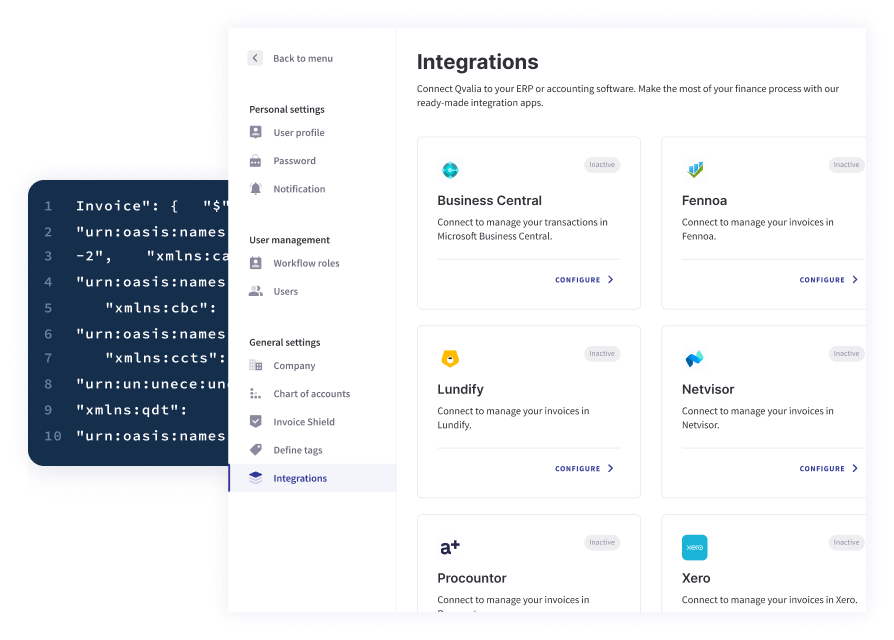
Use Qvalia to get a compliant Peppol e-order management system for your business, either online or ERP-integrated. Receive and review e-orders, communicate with your customers, and take action. Turn orders into invoices with a few clicks, get full insight into your transaction history, and combine e-orders with punchout for seamless B2B e-commerce. Choose a price plan and pay according to your transaction volume — no complexity, and you can be up and running in minutes. Get in touch to book a demo.
Full functionality
- Access to online order management software
- Access to online support
- View incoming e-orders
- Respond to e-orders
- Acknowledge, partially accept or reject e-orders
- View e-order history
- View full e-order content
- Create invoice from e-order
- Upgrade at any time to change transaction volume or access API
Conformité
- Automatic registration to Peppol
- Automatic registration of your unique Peppol ID
- Automatic access to necessary message types
Questions fréquemment posées
What is the difference between an e-order and an e-invoice?
An e-order is the structured purchase order that initiates a transaction; an e-invoice is the structured bill that completes it. E-orders sit closer to the purchasing event, enabling earlier automation and richer analytics. Both are exchanged over Peppol as standardized business messages.
Who needs a Peppol ID for e-orders?
The recipient needs one. Sellers need a Peppol ID to receive e-orders, and buyers need a Peppol ID to receive e-invoices for the ordered goods or services. The ID is registered by your Peppol service provider (access point) and specifies which message types you can receive.
What is the difference between Peppol BIS Order Only, Ordering, and Advanced Ordering?
They differ in how much communication they allow. Order Only is one-way: the supplier cannot respond. Ordering adds supplier responses — acceptance, change, or rejection. Advanced Ordering enables full two-way communication with real-time updating, so both parties can change or cancel the e-order within the same process.
What is the difference between Peppol BIS Ordering and Punch Out?
Peppol BIS Ordering covers the structured exchange of an order and its response (accept, change, reject). Punch Out goes further: it combines order and catalog into a dynamic process, letting the buyer browse the supplier’s catalog with buyer-specific pricing and return a cart as an order — ideal for B2B e-commerce.
Qu'est-ce que punchout?
Punchout (Peppol BIS Punch Out) connects a buyer’s procurement system directly to a seller’s online catalog. The buyer browses with buyer-specific pricing, builds a cart, and returns it to their own system as a structured order — combining the e-commerce experience with automated, lossless ordering.
What is an order response?
A message the seller sends back after receiving an e-order. It can acknowledge, accept in full, accept partially with adjustments, or reject the order, and may include details such as stock availability and delivery time. The buyer’s system can then update the order status automatically.
Are e-orders mandatory?
In public procurement, increasingly. Finland’s State Treasury required public-sector orders to be sent via Peppol from 1 April 2024, extending across applicable procurement through 2026, and more countries are expected to follow. B2G e-invoicing is already mandatory across the EU under Directive 2014/55/EU.